The Dream Begins to Take Shape
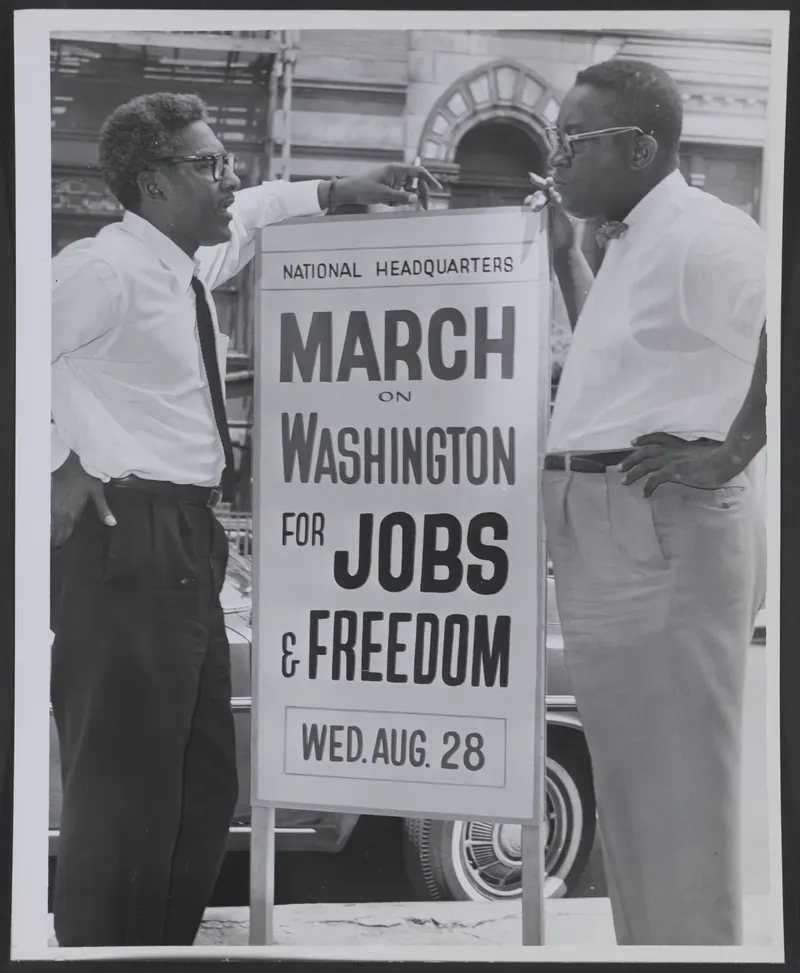
It was the largest gathering for civil rights of its time. An estimated 250,000 people attended the March on Washington for Jobs and Freedom on August 28, 1963, arriving in Washington, D.C. by planes, trains, cars, and buses from all over the country.
The event focused on employment discrimination, civil rights abuses against African Americans, Latinos, and other disenfranchised groups, and support for the Civil Rights Act that the Kennedy Administration was attempting to pass through Congress. This momentous display of civic activism took place on the National Mall, "America's Front Yard" and was the culmination of an idea born more than 20 years before.
While the March was a collaborative effort, sponsored by leaders of various student, civil rights, and labor organizations, the original idea came from A. Philip Randolph, a labor organizer and founder of the Brotherhood of Sleeping Car Porters and the Negro American Labor Council (NALC). His vision for a march on the Nation's Capital dated to the 1940s when he twice proposed large-scale marches to protest segregation and discrimination in the U.S. military and the U.S. defense industry and to pressure the White House to take action. The pressure worked. President Roosevelt signed Executive Order 8802 (Prohibition of Discrimination in the Defense Industry, 1941) and President Truman signed Executive Order 9981 (Desegregation of the Armed Forces, 1948), and Randolph cancelled the marches.
Behind the Scenes of a Movement
By the 1960s, a public expression of dissatisfaction with the status quo was considered necessary and a march was planned for 1963, with Randolph as the titular head. Joining Randolph in sponsoring the March were the leaders of the five major civil rights groups: Roy Wilkins of the National Association for the Advancement of Colored People (NAACP), Whitney Young of the National Urban League (NUL), Martin Luther King, Jr. of the Southern Christian Leadership Conference (SCLC), James Farmer of the Congress of Racial Equality, and John Lewis of the Student Nonviolent Coordinating Committee (SNCC). These "Big Six," as they were called, expanded to include Walter Reuther of the United Auto Workers (UAW), Joachim Prinz of the American Jewish Congress (AJC), Eugene Carson Blake of the Commission on Religion and Race of the National Council of Churches, and Mathew Ahmann of the National Catholic Conference for Interracial Justice. These ten are the "chairmen" named in the March's own manuals and program. In addition, Dorothy Height of the National Council of Negro Women participated in the planning, but she operated in the background of this male dominated, leadership group.
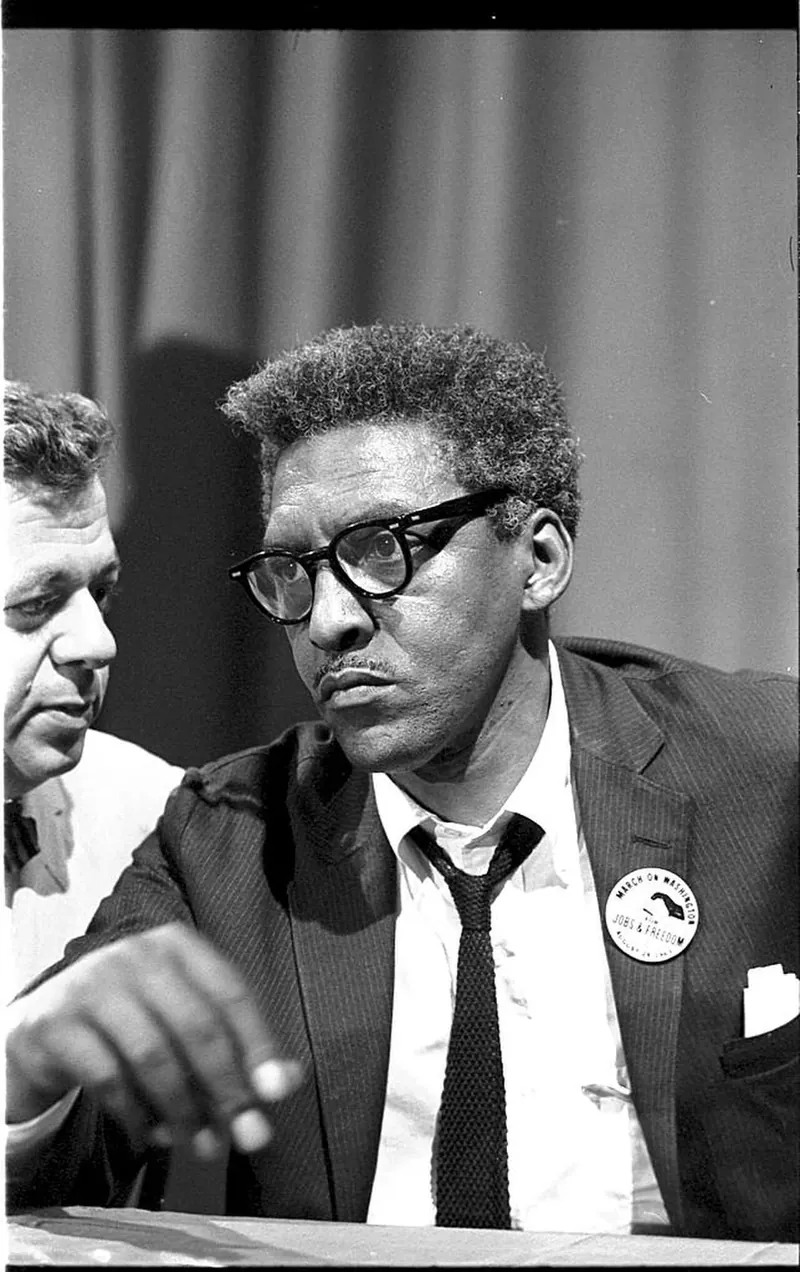
The March was organized in less than 3 months. Randolph handed the day-to-day planning to his partner in the March on Washington Movement, Bayard Rustin, a pioneer of the 1947 Journey of Reconciliation and a brilliant strategist of nonviolent direct action protests. He had practiced on the same ground, helping to organize the 1957 Prayer Pilgrimage and the Youth Marches of 1958 and 1959 (Before the March). Some of the leaders, the NAACP's Roy Wilkins among them, did not want Rustin at the head of the March, so Randolph took the title of director and Rustin, who did the work, became his deputy. Rustin planned everything, from training "marshals" for crowd control using nonviolent techniques to the sound system and setup of porta-potties. Two Organizing Manuals laid out a statement of purpose, specific talking points, and logistics; you can read both on this site (No. 1, No. 2). Rustin saw that to maintain order over such a large crowd, there needed to be a highly organized support structure.
Rustin coordinated a staff of over 200 civil rights activists and organizers to assist in publicizing the march and recruiting marchers (some of their fliers), organizing churches to raise money, coordinating buses and trains, and administering all of the other logistical details. In many ways, the March defied expectations. The number of people that attended exceeded the initial estimates made by the organizers. Rustin had indicated that they expected over 100,000 people to attend - the final estimate was 250,000, 190,000 blacks and 60,000 whites.
Rustin's past was used against the March. On August 13, fifteen days before it, Senator Strom Thurmond attacked him on the Senate floor and had his police record printed in the Congressional Record. Randolph defended him in public, the other leaders stood with him, and he stayed at his post (Arrested, Attacked, Pardoned). The House Un-American Activities Committee kept its own copy of the final manual, with the leaders' names circled (The Copy Congress Kept), and the March was argued over abroad as well, from Beijing to the NAACP's reply (Mao, Wilkins, and the March).
Words That Moved a Nation
With that many people converging on the city, there were concerns about violence. The Washington, D.C. police force mobilized 5,900 officers for the march and the government mustered 6,000 soldiers and National Guardsmen as additional protection. President Kennedy thought that if there were any problems, the negative perceptions could undo the civil rights bill making its way through Congress. In the end, the crowds were calm and there were no incidents reported by police.
While the March was a peaceful occasion, the words spoken that day at the Lincoln Memorial were not just uplifting and inspirational such as Martin Luther King Jr.'s "I Have a Dream" speech, they were also penetrating and pointed. The program handed out at the Lincoln Memorial listed ten demands under the heading "What We Demand," among them a civil rights law "without compromise or filibuster," a $2.00 national minimum wage, a federal jobs program, fair employment practices, and the desegregation of all school districts in 1963 (the program). John Lewis in his speech said that "we do not want our freedom gradually but we want to be free now" and that Congress needed to pass "meaningful legislation" or people would march through the South. Although the SNCC chairman had toned down his remarks at the request of white liberals and moderate black allies, he still managed to criticize both political parties for moving too slowly on civil rights. Others such as Whitney Young and Joachim Prinz spoke of the need for justice, for equal opportunity, for full access to the American Dream promised with the Declaration of Independence and reaffirmed with the passage of the 13th, 14th, and 15th Amendments. They spoke of jobs, and of a life free from the indifference of lawmakers to people's plights.
In the end, after all of the musical performances, speeches, and politics, it was the people that truly made the March on Washington a success. They brought box lunches, having spent all they could spare to get to Washington; some dressed as if attending a church service while others wore overalls and boots; veterans of the Civil Rights Movement and individuals new to the issues locked arms, clapped and sang and walked. Many began without their leaders, who were making their way to them from meetings on Capitol Hill. They could no longer be patient and they could no longer be held back, and so they started to march - Black, White, Latino, American Indian, Jewish, Christian, men, women, famous, anonymous, but ultimately all Americans, all marching for their civil rights.
Afterward
Fifty years after the March, in 2013, President Obama awarded Rustin the Presidential Medal of Freedom (The Medal, 2013). Thirty years after it, another march on Washington, for lesbian, gay, and bi rights, filled the same Mall (Two Marches).