The March on Washington in 1963 looked effortless: a quarter of a million people, buses parked in their zones, marshals in place, the program running on time. It was not Bayard Rustin's first try. Three times in the six years before, he had helped bring a crowd to the same stretch of the Mall.
The Prayer Pilgrimage, 1957
On May 17, 1957, the third anniversary of Brown v. Board of Education, about 25,000 people gathered in front of the Lincoln Memorial for the Prayer Pilgrimage for Freedom. It was the largest demonstration for civil rights the country had seen.
A. Philip Randolph, Ella Baker and Rustin organized it, with the support of the NAACP and the new Southern Christian Leadership Conference. The Stanford King Institute says Rustin "was instrumental in organizing" it; he wrote memos to Martin Luther King Jr. setting out the goals and advised him on what to cover in his speech. Congressman Adam Clayton Powell Jr. had asked the planners not to embarrass the Eisenhower administration, so the event was framed as a prayer meeting.
Mahalia Jackson and Harry Belafonte took part. King spoke last. It was the first time he addressed a national audience, and in the speech remembered as "Give Us the Ballot" he named restoring and enforcing Black Americans' right to vote as a central part of the struggle.
The Youth Marches, 1958 and 1959
The next two came from the students. In August 1958 a small committee headed by Randolph began organizing a Youth March for Integrated Schools, and, according to the King Institute, Rustin coordinated it with him.
On October 25, 1958, about 10,000 young people, mostly of high school and college age, marched to the Lincoln Memorial for the desegregation of the public schools. King was supposed to speak, but he was recovering from a stabbing; Coretta Scott King spoke in his place. A delegation led by Harry Belafonte tried to deliver the marchers' message to President Eisenhower and was turned away.
On April 18, 1959, a second Youth March drew an estimated 26,000 people down the National Mall to a program at the Sylvan Theatre. Its organizers circulated a petition urging the President and Congress to put school integration into effect. King, Randolph, Roy Wilkins, Daisy Bates, Harry Belafonte and Jackie Robinson were among the speakers.
What the rehearsals taught
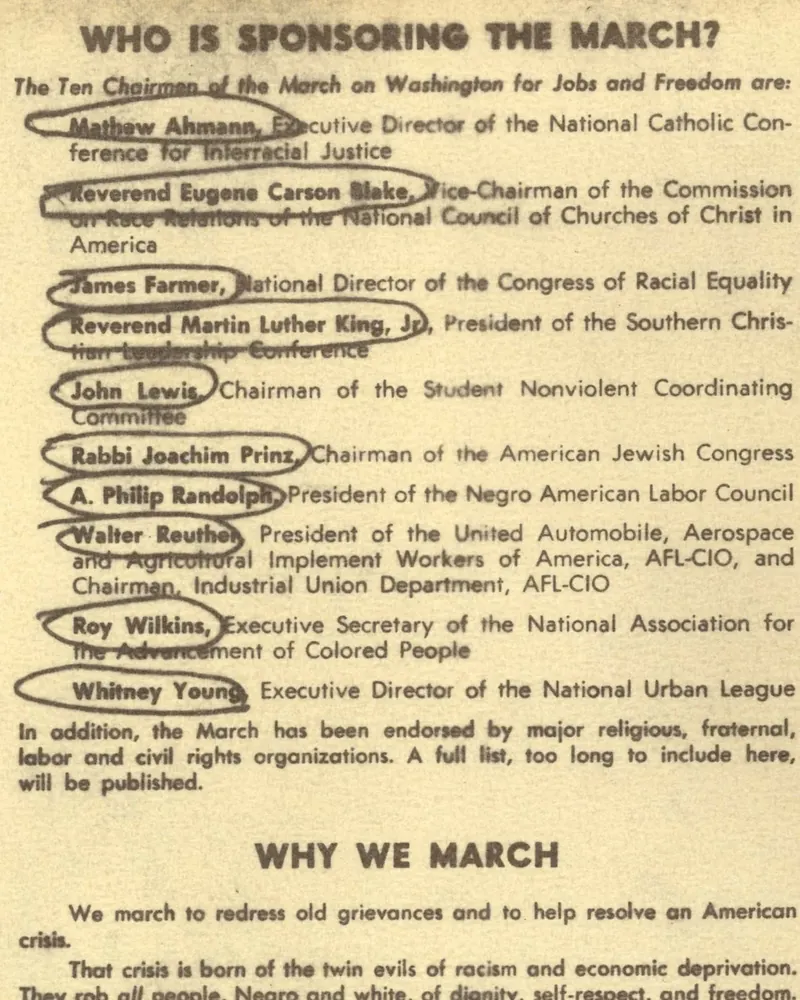
The organizers gained experience: how to bring thousands of people into Washington and home again, peacefully, on a single day. The Prayer Pilgrimage laid the foundation for the larger demonstrations that followed. When Randolph and Rustin proposed a far larger march in 1963, they already knew how (March on Washington, the final organizing manual).
Sources
- Wikipedia, "Prayer Pilgrimage for Freedom," "Youth March for Integrated Schools (1958)" and "(1959)."
- Martin Luther King, Jr. Research and Education Institute, Stanford University, "Rustin, Bayard" and "Youth March for Integrated Schools."