On Tuesday, March 29, 1960, a full page of The New York Times carried a headline borrowed from the paper's own editorial ten days earlier: "Heed Their Rising Voices." It was an appeal for money. Four years later it was the center of one of the most important free-speech cases in American history. Bayard Rustin helped write it.
The ad
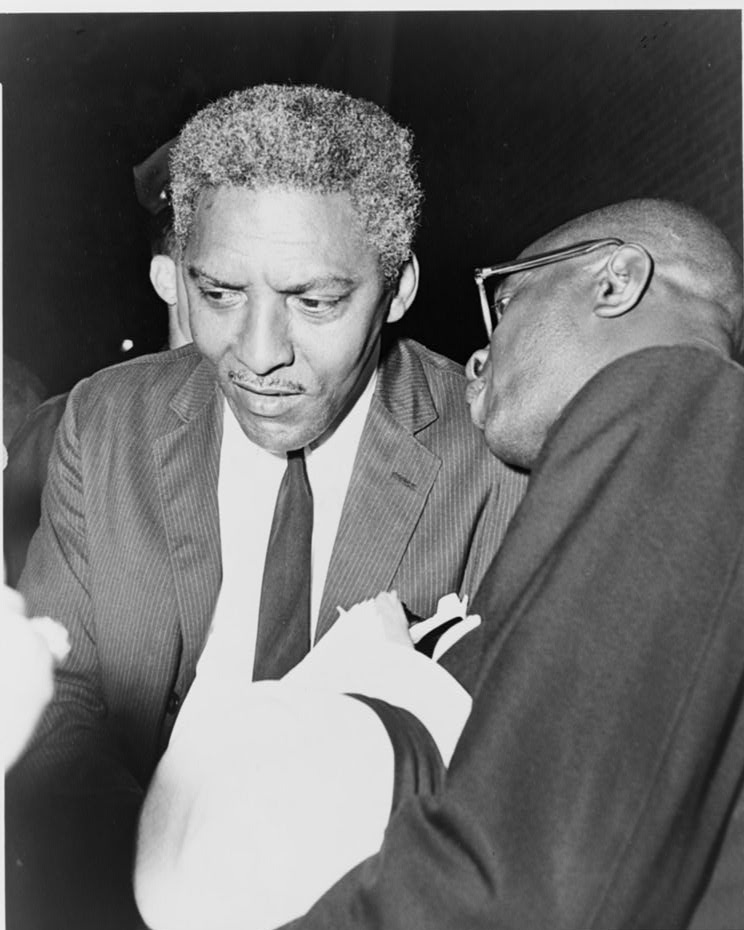
That spring, Black college students across the South were sitting in at lunch counters, and Martin Luther King Jr. had been charged in Alabama with perjury. In New York, King's supporters formed the Committee to Defend Martin Luther King and the Struggle for Freedom in the South. A. Philip Randolph and the Reverend Gardner C. Taylor chaired it. Its executive director, printed at the foot of the ad, was Bayard Rustin. According to JSTOR Daily's annotated edition, the copy was written by Rustin and the playwright John Murray.
The ad praised the students' "creative daring" and King's "quiet heroism," described how Southern officials were answering the protests, and asked readers to give to three causes at once: King's legal defense, the students, and the right to vote. Below it ran the names of supporters, among them Eleanor Roosevelt, Jackie Robinson, Sidney Poitier, Harry Belafonte, Langston Hughes, and Rustin himself, and, under the words "We in the south who are struggling daily for dignity and freedom warmly endorse this appeal," twenty Southern names, all but two of them clergymen.
The lawsuit
Some of what the ad said about Montgomery, Alabama, was wrong. The students on the state capitol steps had sung the national anthem, not "My Country, 'Tis of Thee." Police had been deployed near the Alabama State College campus but had not "ringed" it. King had been arrested four times, not seven.
L. B. Sullivan, the Montgomery city commissioner in charge of the police, was not named anywhere in the ad. He sued anyway, arguing that the attacks on "police" were attacks on him. He sued the Times and four Alabama ministers whose names were on the page. A Montgomery jury awarded him $500,000, every cent he asked for, and the Supreme Court of Alabama upheld it.
The ruling
On March 9, 1964, the Supreme Court of the United States reversed the verdict without a dissent. Writing for the Court, Justice William Brennan said the case had to be judged against "a profound national commitment to the principle that debate on public issues should be uninhibited, robust, and wide-open, and that it may well include vehement, caustic, and sometimes unpleasantly sharp attacks on government and public officials." The ad, he wrote, "as an expression of grievance and protest on one of the major public issues of our time, would seem clearly to qualify for the constitutional protection."
From then on, a public official suing over criticism of their official conduct has to prove "actual malice": that the statement was made "with knowledge that it was false or with reckless disregard of whether it was false or not." Honest mistakes in the heat of public argument are protected. That rule still governs American libel law.
The copy in the archive
The National Archives at Atlanta keeps a copy of the ad as an exhibit in a related Alabama case, Abernathy v. Patterson. You can see the full page and read a transcript on the National Archives' site; look for "Executive Director: Bayard Rustin" in the small print at the bottom.
Sources
- "Heed Their Rising Voices," The New York Times, March 29, 1960: court exhibit in Abernathy v. Patterson, National Archives at Atlanta (NAID 2641477); transcript.
- New York Times Co. v. Sullivan, 376 U.S. 254 (1964) (opinion).
- JSTOR Daily, "“Heed Their Rising Voices”: Annotated" (Rustin and John Murray as the ad's writers).