For most of his life Bayard Rustin was the most important person in the room whose name was left off the program. The reason goes back to one night in Pasadena, California. It took sixty-seven years, and a governor's signature, to set the record straight.
Pasadena, January 1953
In January 1953, police in Pasadena arrested Rustin with two other men in a parked car. He was first charged with vagrancy and lewd conduct, then pleaded guilty to a single charge of "sex perversion," the name California law then gave to consensual sex between men. He served sixty days in jail.
Rustin had never hidden who he was from the people close to him. But this was the first time his sexuality became public, at a time when it was a crime in every state. He resigned from the Fellowship of Reconciliation, the pacifist group that had hired him in 1941, and his bond with its leader, his mentor A. J. Muste, never fully recovered. Rustin moved to the War Resisters League as its executive secretary. Later, an American Legion chapter in Montana used the conviction to try to cancel his lectures in the state.
Behind the scenes
The arrest followed him into the civil rights movement. He helped Martin Luther King Jr. through the Montgomery bus boycott in 1956 and helped found the Southern Christian Leadership Conference in 1957. Then, in 1960, Congressman Adam Clayton Powell Jr. threatened to tell the press a false story that Rustin and King were lovers unless they called off a march they were planning at the Democratic convention. King dropped the march, and Rustin left the SCLC.
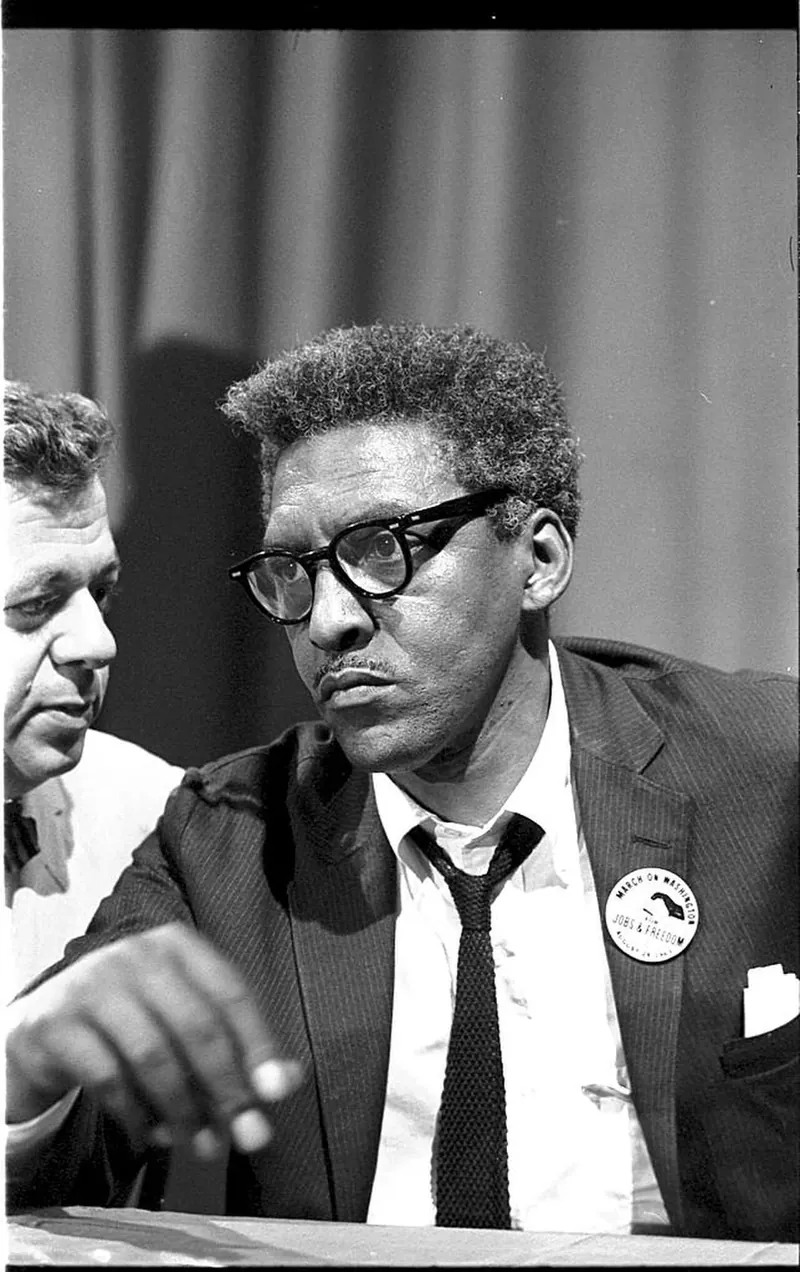
When A. Philip Randolph chose Rustin to organize the March on Washington in 1963, the NAACP's Roy Wilkins objected that the march was too important to put "a person of his liabilities at the head." The compromise was a title: Randolph became the director, and Rustin, who did the work, became his deputy.
The Senate floor, August 1963
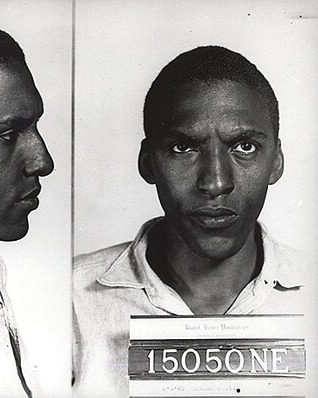
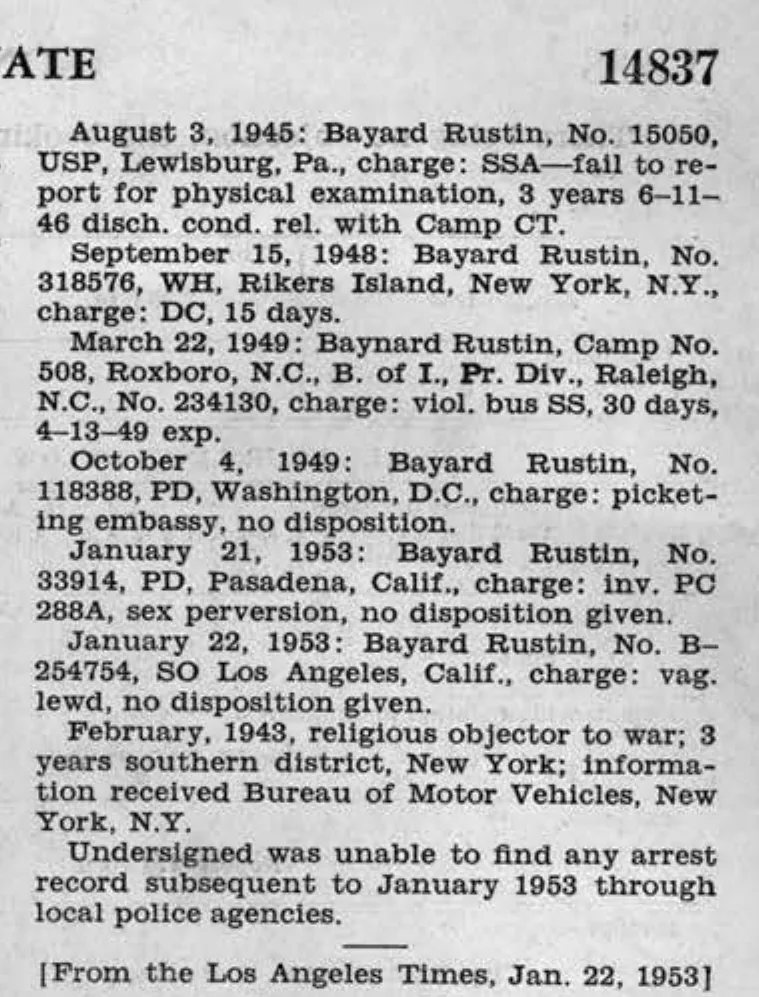
On August 13, 1963, fifteen days before the March, Senator Strom Thurmond of South Carolina rose in the Senate to attack it through its organizer. His target was a friendly Washington Post profile of Rustin, which he said had toned down the facts. "Mr. Rustin's criminal record," he said, "serves as a good beginning point." He had that record printed in the Congressional Record: the federal prisoner numbers from the war years, when Rustin, a conscientious objector, went to prison rather than serve; the 1949 chain gang in North Carolina; and the Pasadena entry, "charge: inv. PC 288A, sex perversion." He added two 1953 Los Angeles Times stories about the arrest and a copy of the booking slip from the Los Angeles County jail, and he went over Rustin's youth in the Young Communist League. "Communist, draft dodger, homosexual," the phrase often used for the attack, is a later summary of it, not Thurmond's words.
In the House, Representative John Ashbrook of Ohio read into the Record his reply to the March organizers' invitation. He listed the same charges, prison for refusing the draft, the 1953 conviction, the Young Communist League, and asked whether the leaders had known them when they gave Rustin the job.
The plan was to split the March's leaders. It failed. Randolph defended Rustin in public, the other leaders stood with him, and he stayed at his post. On August 28 about 250,000 people came to Washington, and the March ran the way he had drilled it, down to the bus captains and the volunteer marshals. Nine days later, the cover of Life magazine showed Rustin and Randolph together and called them "the leaders" of the March.
Still, the attack left its mark. Rustin's arrest was now part of the official record of the United States Congress, and for the rest of his career he was usually the strategist in the background rather than the face at the microphone.
Sacramento, February 2020
Rustin died in 1987, his conviction still on the books. In January 2020, two California legislators, State Senator Scott Wiener, chair of the Legislative LGBT Caucus, and Assemblywoman Shirley Weber, chair of the Legislative Black Caucus, asked Governor Gavin Newsom to pardon him.
Newsom signed the pardon on February 5, 2020. The same day he set up a process for anyone convicted under California's old laws against gay sex to ask for a pardon of their own, so that Rustin's case would open the door for people whose names were never famous.
Pasadena, where it began, followed in 2023. On June 5 its city council passed a resolution that the city "celebrates and concurs in the Governor's 2020 pardon of Bayard Rustin."
Read more
- Rustin's life from the start: Bayard Rustin Biography.
- How he organized the March: March on Washington and the final organizing manual he wrote for it.
- Senator Thurmond's speech and Rustin's printed record: Congressional Record, vol. 109, pp. 14836–14842 (August 13, 1963) (govinfo). Representative Ashbrook's letter: vol. 109, p. 15665 (govinfo).
- The governor's announcement of the pardon.