Bayard Rustin is remembered for one day in Washington. But for forty years his idea of nonviolence travelled the world with him, from the followers of Gandhi to the independence movements of Africa, the first great anti-nuclear march in Britain, and the refugee camps and polling stations of the 1980s.
India, 1948
Rustin had organized support for India's independence from prison during the Second World War. In 1948, months after Gandhi was assassinated, he travelled to India for a conference that had been planned before Gandhi's death, to learn nonviolent resistance from the people who had used it to end British rule. He brought the lessons home, and a few years later he brought them to Martin Luther King Jr. in Montgomery.
Africa's independence movements, 1947 – 1952
In the same years he met the leaders of the independence movements in what are now Ghana and Nigeria. In 1951 he helped form the Committee to Support South African Resistance, to support resistance to apartheid in South Africa. It later became the American Committee on Africa.
London and Aldermaston, 1958
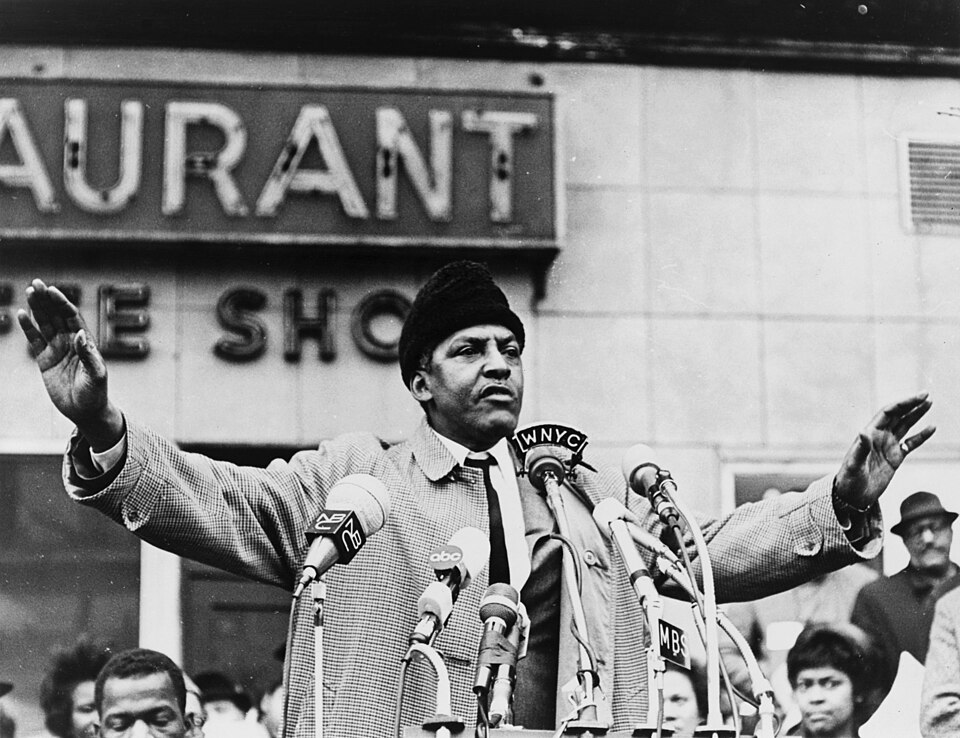
At Easter 1958, several thousand people set out from Trafalgar Square in London on a four-day march to Britain's Atomic Weapons Establishment at Aldermaston, to protest nuclear weapons. Rustin, representing the American War Resisters League, sat on the committee that organized it, and spoke to the crowd in Trafalgar Square. The march was repeated in later years and became a symbol of Britain's movement against nuclear weapons.
Into the Sahara, 1959 – 1960
At the end of 1959, France was preparing to test its first atomic bomb in the Algerian Sahara. An international team of pacifists set out from Accra, Ghana, to drive north through what was then Upper Volta, now Burkina Faso, toward the test site in protest. Rustin was part of it. He later called it "the most significant non-violent project" he had ever joined. France tested the bomb in February 1960.
Witness for human rights, 1979 – 1987
In his last decade Rustin worked with Freedom House and other groups as a human-rights and election observer:
- Zimbabwe-Rhodesia, 1979. He went with a Freedom House delegation to watch the country's first election after the end of white minority rule.
- The Thai–Cambodian border, 1980. He joined the "March for Survival," with the singer Joan Baez and the actor Liv Ullmann, to press for food and medical aid to reach Cambodia after years of war and genocide.
- Vienna, 1986. President Ronald Reagan named him, at 74, one of the public members of the American delegation to the Vienna follow-up meeting of the Conference on Security and Cooperation in Europe, which reviewed the 1975 Helsinki Final Act: human rights, economic relations, and security.
- Haiti, 1987. His last mission abroad. He fell ill soon after he returned, and he died in New York on August 24, 1987.
Read more
- Rustin's life from the start: Bayard Rustin Biography.
- How he learned nonviolence at home: Inside Ashland and Lewisburg.
- Swarthmore College's Global Nonviolent Action Database on the Sahara Protest Team.
- The International Rescue Committee on Rustin and refugees.