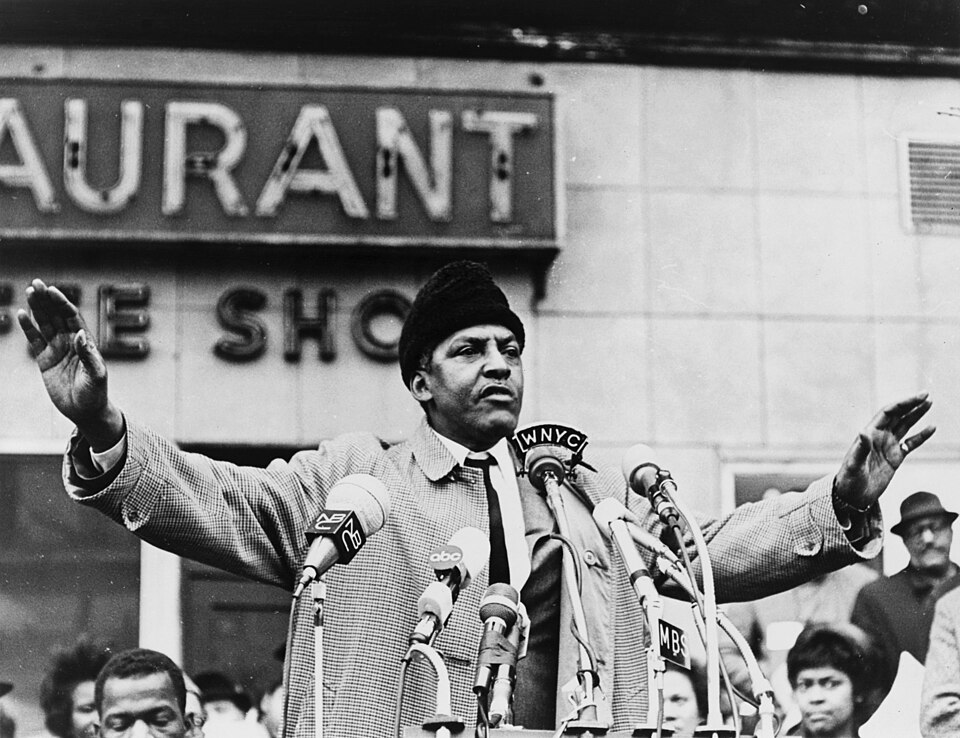
Most stories about Bayard Rustin and segregated travel happen on buses: the 1942 seat he would not give up near Nashville, the 1947 Journey of Reconciliation through Virginia and North Carolina. This one happens on a train, and it ends in a federal courtroom in New York. Almost nobody has told it, because it survives only as a thin court file in the National Archives.
A ticket to Knoxville
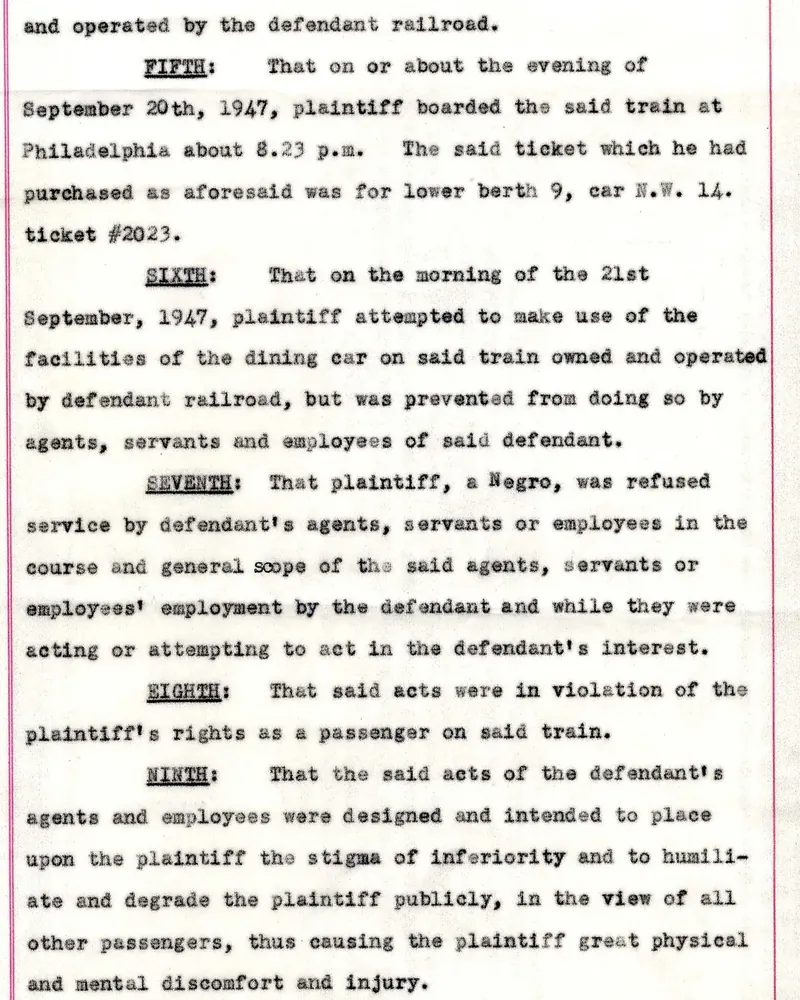
On or about September 18, 1947, Rustin bought a Pullman ticket in New York City for a Southern Railway train to Knoxville, Tennessee. On the evening of September 20 he boarded at Philadelphia at about 8:23 p.m. His ticket was for lower berth 9, car N.W. 14.
The next morning he went to the dining car. The railroad's staff would not serve him.
"The stigma of inferiority"
A year later Rustin sued Southern Railway in the Supreme Court of the State of New York, asking $5,000 in damages and punitive damages on top. His lawyers were the Manhattan firm of Rachlin, Migdal, Cohen & Diamond. The complaint is short and plain. It says that he was "a Negro," that he "was refused service," and that the refusal broke his rights as a passenger and the laws of the United States. Its ninth paragraph says what the refusal was for:
“…designed and intended to place upon the plaintiff the stigma of inferiority and to humiliate and degrade the plaintiff publicly, in the view of all other passengers…”
The complaint also has a slip that nobody fixed: its fourth paragraph says the "defendant purchased" the ticket, when it means the plaintiff.
The railroad's answer
Southern Railway, a Virginia company, moved the case to the federal court in Manhattan on September 16, 1948. Its lawyers were the Wall Street firm Davis Polk Wardwell Sunderland & Kiendl. Their answer, filed October 20, 1948, denied Rustin's account paragraph by paragraph, and then made a frank defense.
At the time of the incident, it said, the railroad had a rule, in effect since March 1, 1946, "setting aside certain tables in defendant's dining car for the exclusive use of colored passengers." The Interstate Commerce Commission had approved that rule on September 5, 1947, about two weeks before Rustin's trip. If Rustin wanted to challenge the rule, the railroad argued, he had to go to the Commission, not to a court.
In other words, alongside its denials, the railroad's defense was that seating Black passengers apart was its policy, and that the government had approved it.
The rule falls
Rustin's case sat on the docket. Meanwhile another Black passenger was fighting the same railroad over the same kind of rule. Elmer Henderson, a federal employee, had been refused dinner on a Southern Railway train in Virginia in 1942, and his complaint worked its way up through the Commission and the courts for eight years.
On June 5, 1950, the Supreme Court decided Henderson v. United States. The rule in front of the justices was Southern Railway's rule of March 1, 1946, the same rule the railroad had cited against Rustin: ten tables for white passengers, one table of four seats for Black passengers, and a curtain drawn between them during every meal. The Court held that it broke the Interstate Commerce Act. "The curtains, partitions and signs," Justice Harold Burton wrote, "emphasize the artificiality of a difference in treatment which serves only to call attention to a racial classification of passengers holding identical tickets and using the same public dining facility."
A quiet ending
Six months later, on December 13, 1950, the lawyers for both sides signed a one-sentence stipulation: the action "is discontinued without costs to either party against the other." The court clerk marked it "So Ordered" on March 27, 1951. The file does not say why Rustin's side let the case go, or whether anything was paid.
What the file does keep is Rustin's own account, sworn in a court of law, of what a dining car did to him in 1947, and the railroad's own statement of the rule it stood behind. You can read all twelve pages, with transcripts, in the court file.
Sources
- Bayard Rustin v. Southern Railway Company, Civil Action 47-371, U.S. District Court for the Southern District of New York: petition for removal and complaint, September 16, 1948 (NAID 203270644); answer, October 20, 1948 (NAID 203270648); stipulation of discontinuance, December 13, 1950, so ordered March 27, 1951 (NAID 203270659). Records of District Courts of the United States, National Archives at New York (case file).
- Henderson v. United States, 339 U.S. 816 (1950) (opinion).