The March on Washington made Bayard Rustin famous as the man who could fill a city. Five months later his own city asked him to do it again, and he did, with children.
Separate in the North
Segregation had been illegal in New York City's schools since 1920. But the city's neighborhoods were divided by race, and so were its schools. Schools that mostly enrolled Black and Puerto Rican children tended to have worse facilities, less experienced teachers and severe overcrowding; some ran on split shifts, with as little as four hours of class a day.
Parents and activists had pressed the Board of Education for years to integrate. Just before the boycott the Board released a three-year plan, with limited rezoning and steps against overcrowding. Its critics said it was far too little. White neighborhood groups organized against busing and in defense of the schools closest to home.
The organizer
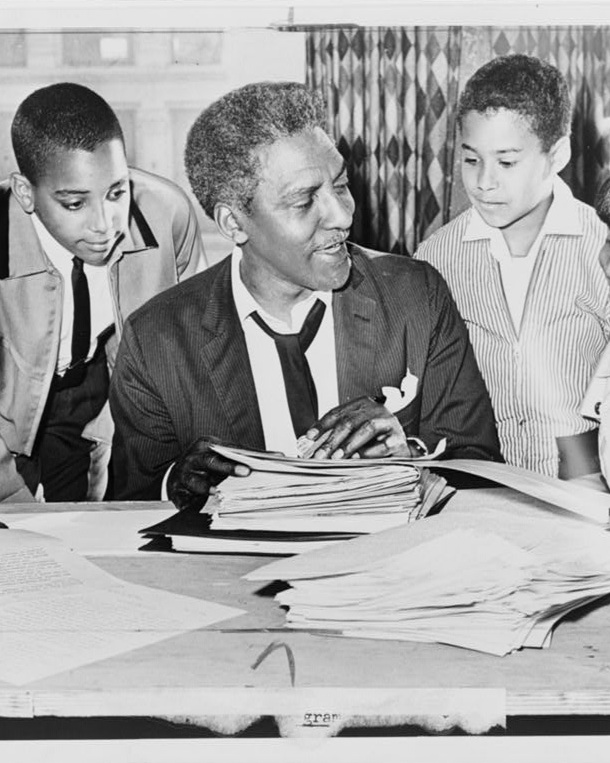
The boycott was led by the Reverend Milton Galamison, chair of the Citywide Committee for Integrated Schools, with the NAACP, the Congress of Racial Equality, the National Urban League and parents' groups behind him. To run it, the committee recruited Rustin.
A few days before, The New York Times published an editorial headed "A Boycott Solves Nothing."
February 3, 1964
On Monday, February 3, about 45 percent of New York City's public school students stayed home. An estimated 464,361 students and teachers took part, more than the number who had marched on Washington the summer before. Some 90,000 to 100,000 of the children went instead to "Freedom Schools," classes taught by community volunteers in churches, community rooms and homes. Of the city's 43,865 teachers, 3,357 were absent, three times the usual number, despite warnings from the superintendent of schools. Demonstrators rallied at the Board of Education, at City Hall, and at the office of Governor Nelson Rockefeller.
The city's newspapers were astonished by the turnout, and by the complete absence of violence or disorder.
What came after
The boycott did not force the Board of Education to change course, and a second boycott the next month drew far fewer people. Five months later Congress passed the Civil Rights Act of 1964, whose school provisions left room for segregation to continue in Northern cities such as New York, Boston, Chicago and Detroit. New York's schools are still among the most segregated in the country.
Freedom Day may be the largest civil rights protest of the 1960s. It rarely appears in history textbooks, perhaps because it does not fit the familiar story that the civil rights movement happened in the South.
Sources
- Wikipedia, "New York City school boycott," and the sources it cites, among them Adam Sanchez, "The Largest Civil Rights Protest You've Never Heard Of," Rethinking Schools (2019), and Yasmeen Khan, "Demand for School Integration Leads to Massive 1964 Boycott," WNYC (2016).