On the morning of March 29, 1990, President George H. W. Bush gave his first major speech about AIDS. He had been in office fourteen months. By then the epidemic had killed tens of thousands of Americans, and activists had spent years asking the White House to say the word out loud.
The speech
The President spoke at 11:16 a.m. in the Arlington Ballroom of the Crystal Gateway Marriott in Arlington, Virginia, across the river from Washington. His audience was the National Leadership Coalition on AIDS: about 500 people, mostly business and health executives working on AIDS in the workplace.
Much of what he said was kind. He asked Americans to treat people with HIV with compassion: "We don't fire them; we don't evict them." But he announced no new money and no new program.
The sign
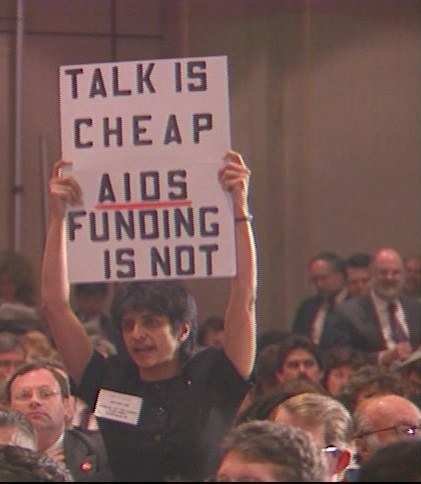
Urvashi Vaid, the executive director of the National Gay and Lesbian Task Force, was one of the invited guests. While the President spoke, she stood up, almost directly in front of him, and held a hand-lettered sign over her head:
“Talk is cheap, AIDS funding is not.”
The White House's own film crew recorded her standing in the crowd, sign held high, for about eighteen seconds. The next day's Los Angeles Times reported that she called out, "Mr. President, you don't understand. We need funding."
She was not the only one. The official transcript of the speech records another voice from the audience: "What have you been doing for 14 months? You haven't said the 'A' word yet." The Los Angeles Times reported a second protester, "one unidentified man," shouting about the fourteen months. Those words are sometimes put in Vaid's mouth, but the record keeps the two protests apart.
What she was asking for
Twelve days later the Task Force explained why she stood up, in an editorial by its board co-chairs. It listed five demands:
- raise federal AIDS spending from about $1.75 billion to $2.8 billion;
- end the immigration and visitor rules that barred people with HIV, which were already threatening the International AIDS Conference planned for San Francisco that June;
- daily leadership and advocacy on AIDS, not one speech;
- attention to the people the epidemic was hitting hardest: people of color, the poor, the homeless, women, drug users, and gay and bisexual men;
- promising treatments made available to everyone with AIDS.
The White House answers
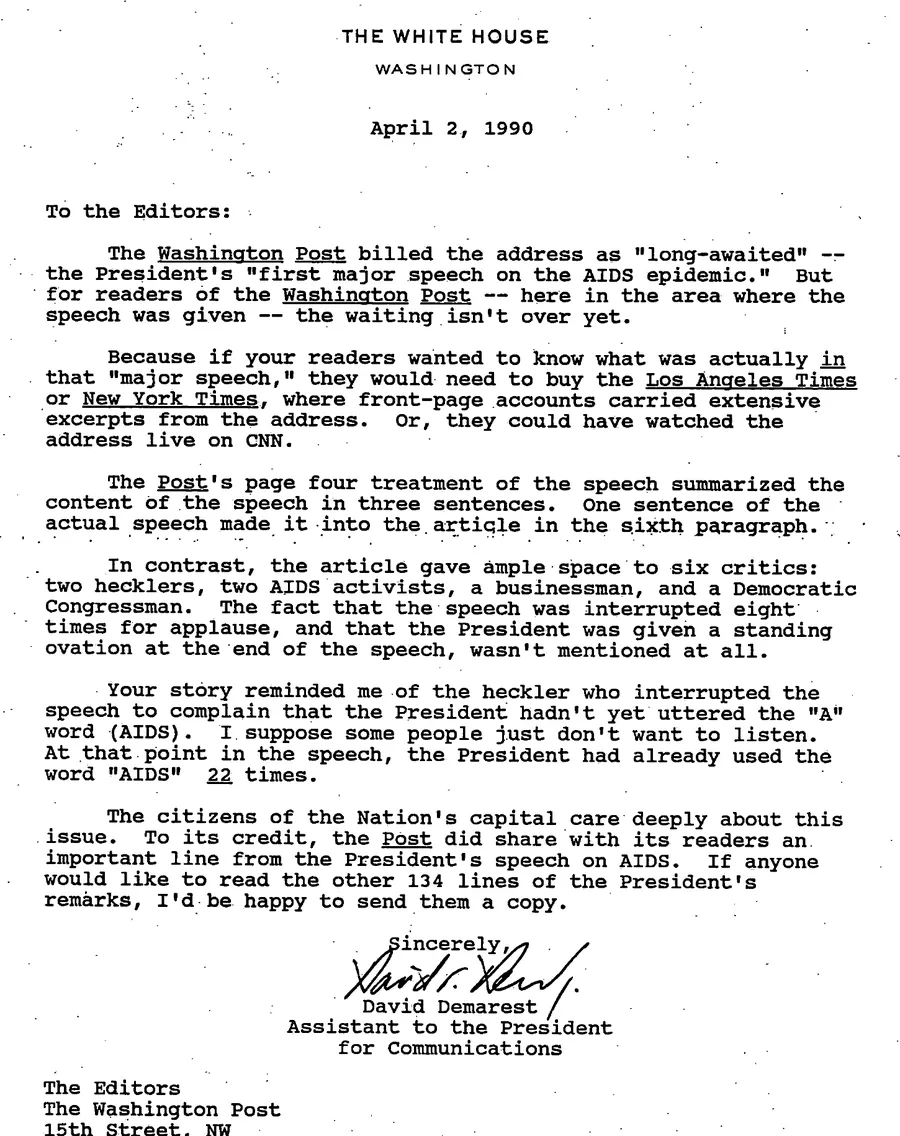
The President's staff kept a file on the speech, now at the Bush Presidential Library. It shows how the protest landed. On April 2, the White House communications director, David Demarest, drafted letters to The Washington Post complaining that its story had given "ample space to six critics," including "two hecklers," and pointing out that the President had already used the word "AIDS" 22 times.
The sign stayed with Vaid, and the price of holding it came quickly. Twenty-five days later, the White House struck her name from the guest list for the signing of a law her own organization had spent four years fighting for. That story is the next chapter: Struck from the List.
Sources
- President Bush, "Remarks to the National Leadership Coalition on AIDS," March 29, 1990, Public Papers of the Presidents (Bush Library).
- White House Television, "Address to National Coalition on AIDS," tape MT560, March 29, 1990 (National Archives, NAID 647290055). The footage does not caption Vaid by name; the Task Force and the Associated Press both identify her as the woman with this sign at this speech.
- Bush Presidential Library, speechwriting files for the speech, including the Los Angeles Times clipping of March 30, 1990, and Demarest's draft letters (National Archives, NAID 323152873).
- National Gay and Lesbian Task Force, "Why Urvashi Vaid Stood Up to Speak to George Bush," April 10, 1990 (UNT Digital Library).