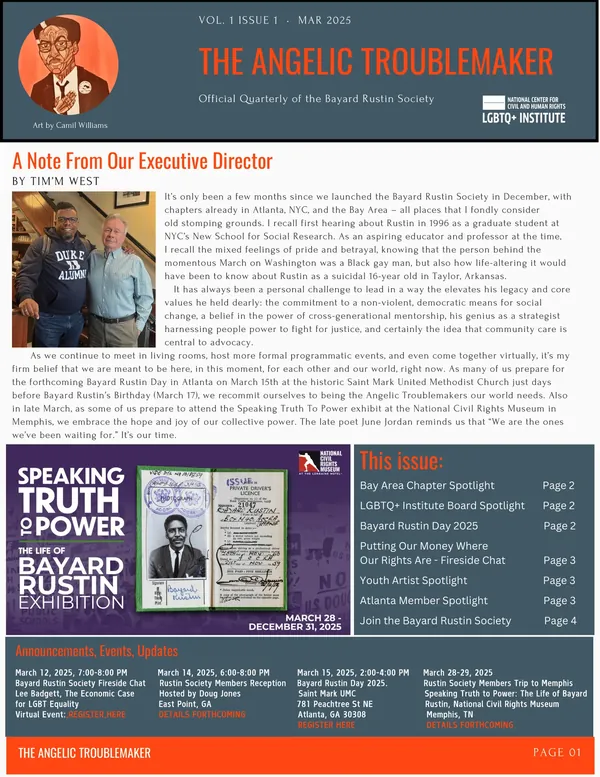
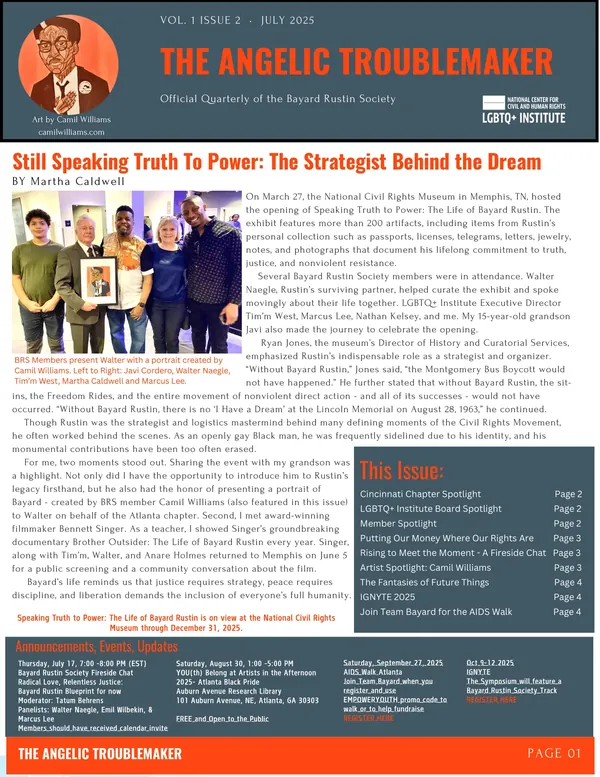
Right to Work Laws: A Trap
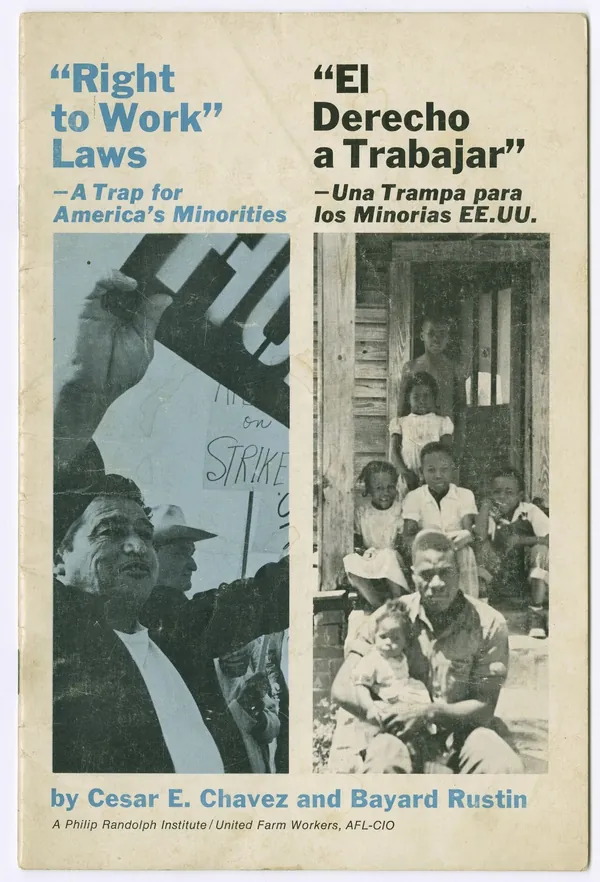
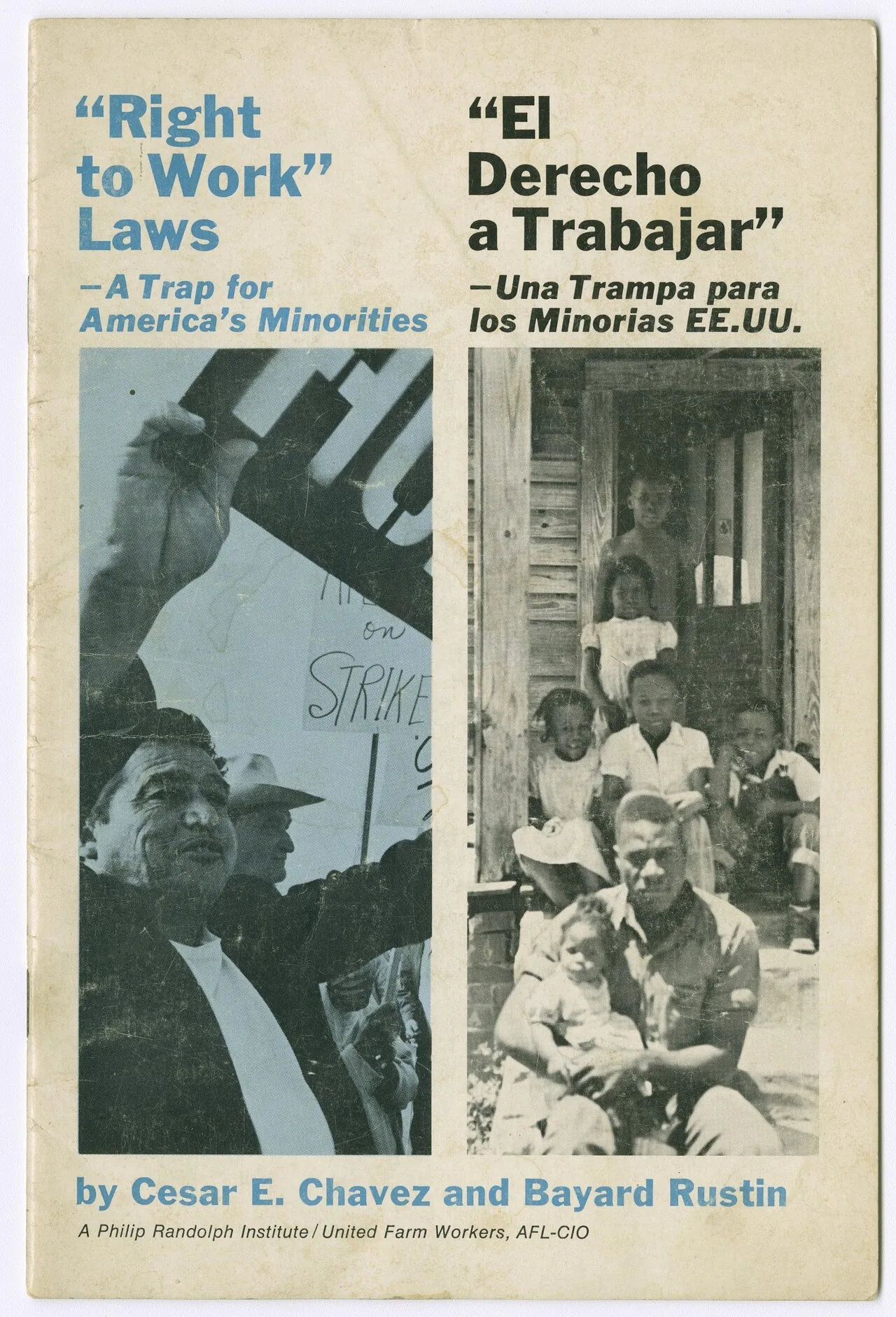
[Left half, in English:]
"Right to Work" Laws
—A Trap for America's Minorities
[Photograph: a man in the foreground at a picket line, a sign reading "on STRIKE" behind him]
[Right half, in Spanish:]
"El Derecho a Trabajar"
—Una Trampa para los Minorias EE.UU.
[Photograph: a family, children and a man holding a baby, on the porch of a wooden house]
by Cesar E. Chavez and Bayard Rustin
A Philip Randolph Institute / United Farm Workers, AFL-CIO
[Left page, English column:]
Foreword
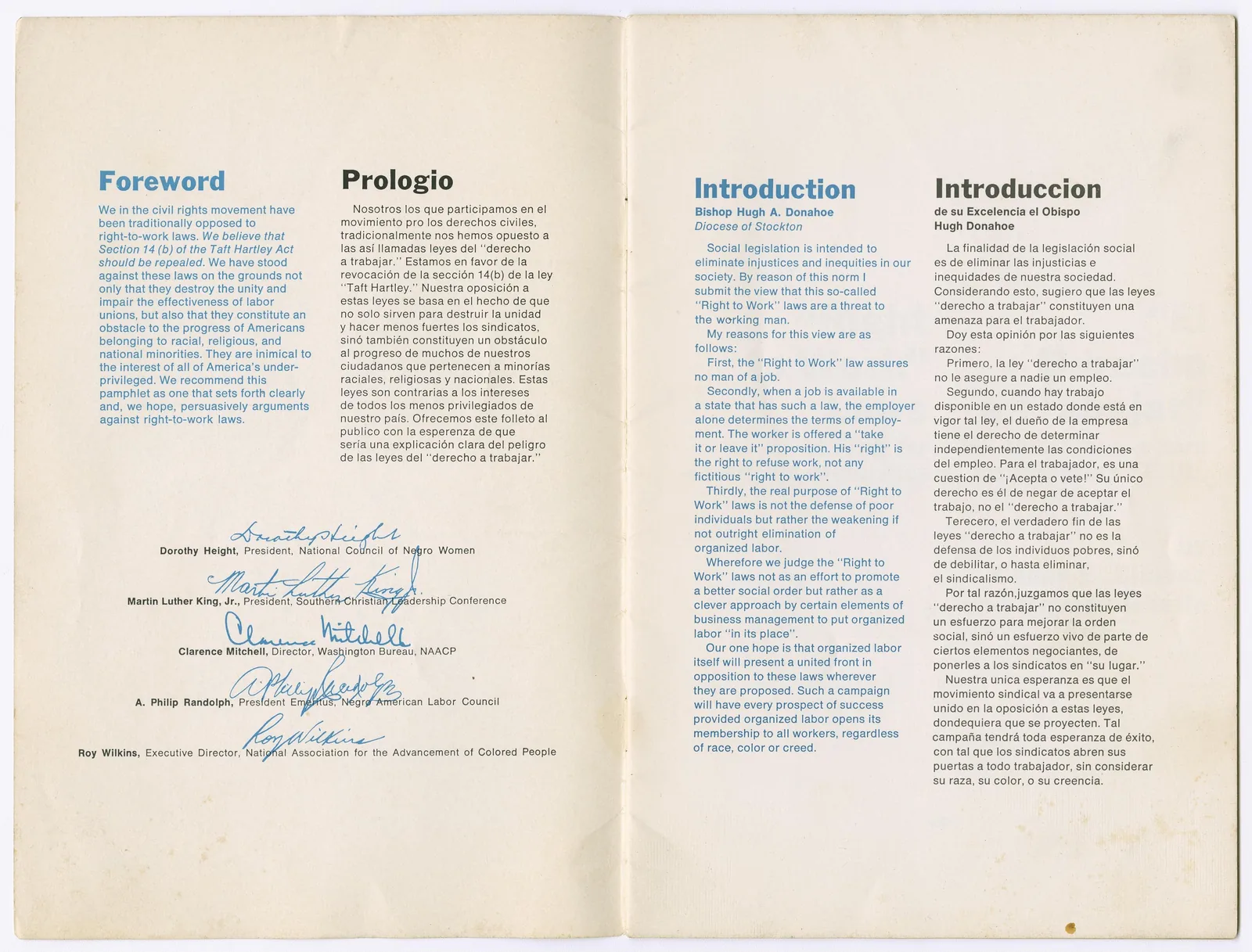
We in the civil rights movement have been traditionally opposed to right-to-work laws. We believe that Section 14 (b) of the Taft Hartley Act should be repealed. We have stood against these laws on the grounds not only that they destroy the unity and impair the effectiveness of labor unions, but also that they constitute an obstacle to the progress of Americans belonging to racial, religious, and national minorities. They are inimical to the interest of all of America's underprivileged. We recommend this pamphlet as one that sets forth clearly and, we hope, persuasively arguments against right-to-work laws.
[Left page, Spanish column:]
Prologio
Nosotros los que participamos en el movimiento pro los derechos civiles, tradicionalmente nos hemos opuesto a las así llamadas leyes del "derecho a trabajar." Estamos en favor de la revocación de la sección 14(b) de la ley "Taft Hartley." Nuestra oposición a estas leyes se basa en el hecho de que no solo sirven para destruir la unidad y hacer menos fuertes los sindicatos, sinó también constituyen un obstáculo al progreso de muchos de nuestros ciudadanos que pertenecen a minorías raciales, religiosas y nacionales. Estas leyes son contrarias a los intereses de todos los menos privilegiados de nuestro país. Ofrecemos este folleto al publico con la esperanza de que sería una explicación clara del peligro de las leyes del "derecho a trabajar."
[Left page, signatures, across both columns:]
[Signature] Dorothy Height, President, National Council of Negro Women
[Signature] Martin Luther King, Jr., President, Southern Christian Leadership Conference
[Signature] Clarence Mitchell, Director, Washington Bureau, NAACP
[Signature] A. Philip Randolph, President Emeritus, Negro American Labor Council
[Signature] Roy Wilkins, Executive Director, National Association for the Advancement of Colored People
[Right page, English column:]
Introduction
Bishop Hugh A. Donahoe
Diocese of Stockton
Social legislation is intended to eliminate injustices and inequities in our society. By reason of this norm I submit the view that this so-called "Right to Work" laws are a threat to the working man.
My reasons for this view are as follows:
First, the "Right to Work" law assures no man of a job.
Secondly, when a job is available in a state that has such a law, the employer alone determines the terms of employment. The worker is offered a "take it or leave it" proposition. His "right" is the right to refuse work, not any fictitious "right to work".
Thirdly, the real purpose of "Right to Work" laws is not the defense of poor individuals but rather the weakening if not outright elimination of organized labor.
Wherefore we judge the "Right to Work" laws not as an effort to promote a better social order but rather as a clever approach by certain elements of business management to put organized labor "in its place".
Our one hope is that organized labor itself will present a united front in opposition to these laws wherever they are proposed. Such a campaign will have every prospect of success provided organized labor opens its membership to all workers, regardless of race, color or creed.
[Right page, Spanish column:]
Introduccion
de su Excelencia el Obispo Hugh Donahoe
La finalidad de la legislación social es de eliminar las injusticias e inequidades de nuestra sociedad. Considerando esto, sugiero que las leyes "derecho a trabajar" constituyen una amenaza para el trabajador.
Doy esta opinión por las siguientes razones:
Primero, la ley "derecho a trabajar" no le asegure a nadie un empleo.
Segundo, cuando hay trabajo disponible en un estado donde está en vigor tal ley, el dueño de la empresa tiene el derecho de determinar independientemente las condiciones del empleo. Para el trabajador, es una cuestion de "¡Acepta o vete!" Su único derecho es él de negar de aceptar el trabajo, no el "derecho a trabajar."
Terecero, el verdadero fin de las leyes "derecho a trabajar" no es la defensa de los individuos pobres, sinó de debilitar, o hasta eliminar, el sindicalismo.
Por tal razón,juzgamos que las leyes "derecho a trabajar" no constituyen un esfuerzo para mejorar la orden social, sinó un esfuerzo vivo de parte de ciertos elementos negociantes, de ponerles a los sindicatos en "su lugar."
Nuestra unica esperanza es que el movimiento sindical va a presentarse unido en la oposición a estas leyes, dondequiera que se proyecten. Tal campaña tendrá toda esperanza de éxito, con tal que los sindicatos abren sus puertas a todo trabajador, sin considerar su raza, su color, o su creencia.
[Left page, otherwise blank:]
[Printer's emblem at the foot of the page: a small blue oval badge reading [illegible] PRINTING / TRADES [illegible] COUNCIL / [NEW YORK?]]
[Right page, English column:]
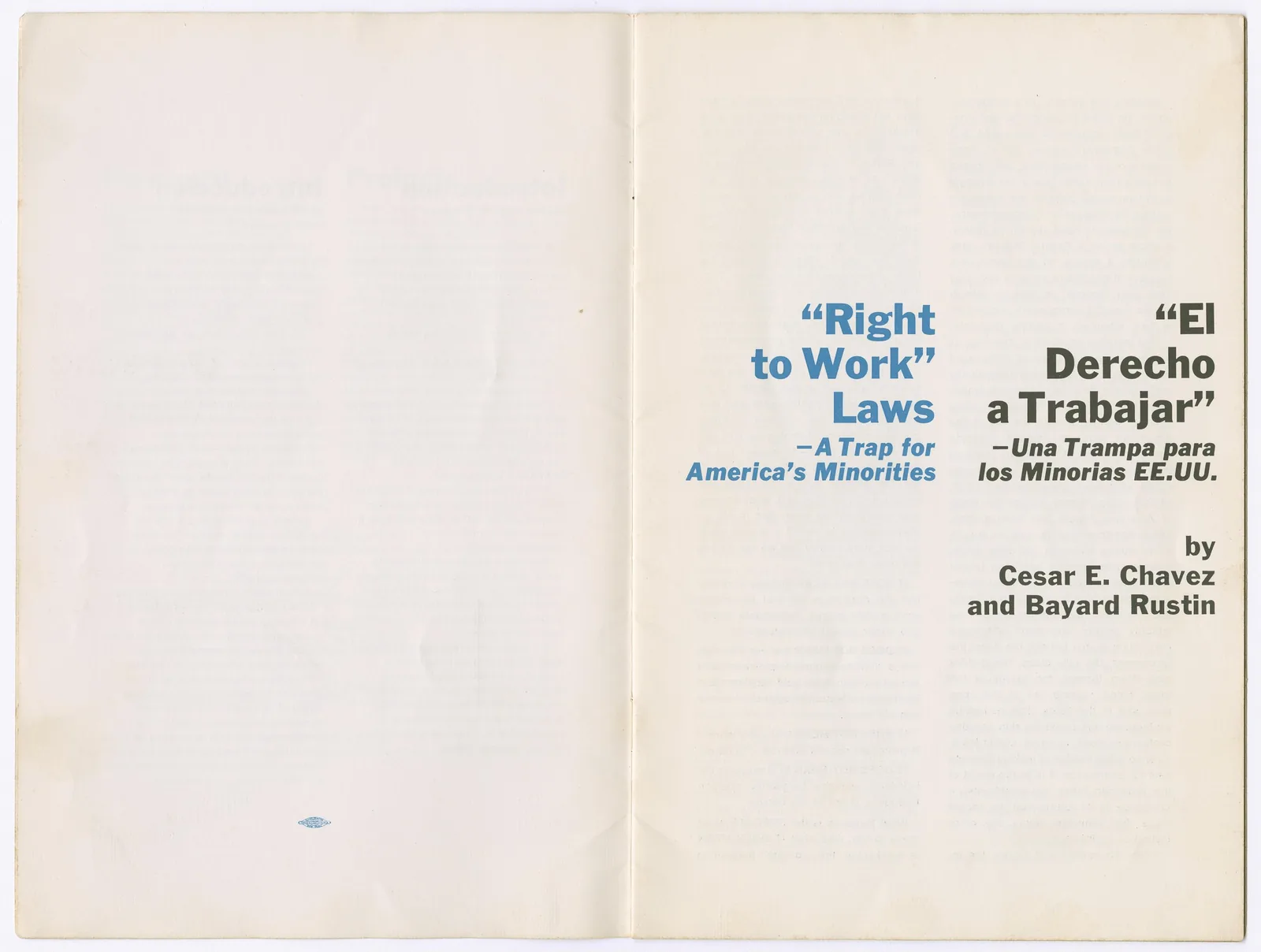
"Right to Work" Laws
—A Trap for America's Minorities
[Right page, Spanish column:]
"El Derecho a Trabajar"
—Una Trampa para los Minorias EE.UU.
by Cesar E. Chavez and Bayard Rustin
[Left page, English column 1:]
America is a country born in libertarianism. Its basic philosophical and constitutional documents guarantee and affirm democratic values. Yet so many millions of our people have been forced to spend their entire lives in the struggle to obtain social, political and economic justice. The Declaration of Independence, the Constitution itself, the Bill of Rights, a whole series of Federal Statutes—they articulate a course for the democratic conduct of our affairs, yet so many of us have been doomed to fight as though we are creating a democracy, instead of, in fact, inheriting a historic birthright.
This paradox touches in one way or another upon the lives of millions of Americans. It has been most dramatically evidenced in the lives of Mexican Americans, Negroes, Puerto Ricans and other minority groups, and in the life of the American labor movement. Nobody knows more about American freedom than the Mexican-American, the Negro, those who have never really had it, whose entire journey across the stage of American history has been a long, bitter, heartbreaking journey in search of an elusive birthright. No other social movement in America has been forced to walk as doggedly as the labor movement has, the bloody road to labor dignity and industrial democracy. Labor and minority groups have been where the real action is—the bullets, the dogs, the lynchropes, the billy clubs, blood dripping down through the leaves of the trees, blood running out of the open shop and in the fields. This makes us brothers not only under the skin, but also brothers in blood, in sweat, and in tears, all shed in the service of making America safe for democracy. It is to the credit of the American labor movement, and a challenge to its future, that we cannot make that statement about any other institution in America.
When the racists and bigots, the industrialists and the corporation farmers were not shedding our blood, they were blocking our way with all kinds of stratagems. We have heard them all—"Property Rights," "States Rights," "Right to Work." All of these slogans, as you will have noticed, and as you will still notice, have been uttered in ringing tones of idealism and individual freedom. But that is the special genius of those who would deny the right of others and hoard the fruits of democracy for themselves: They evade the problems and complex challenges of equal justice by reducing them to primitive oversimplifications that plead for nothing else but the perpetuation of their own special, exploitative interests.
[Left page, English column 2, continued from column 1:]
The present battle of some of the most powerful interests in this country to retain the so-called right-to-work laws falls squarely within the tradition of these primitive self-serving strategies. This slogan—Right to Work—developed out of the license granted by Section 14(b) of the Taft Hartley Act, is deceptive and insidious. On the face of it, what working man would not be interested in his inalienable right to work? It is only when we look more closely that we see it does not mean that at all.
IT DOES NOT MEAN that every worker has the right to a job and to receive work at fair wages, reasonable hours, and under decent labor standards.
IT DOES NOT MEAN that every worker has a right to secure employment with proper provisions for paid vacations and insurance safeguards against sickness and old age.
IT DOES NOT MEAN that every worker is protected against arbitrary discharge.
IT DOES NOT MEAN to strengthen the individual worker's bargaining position through a union of his choice.
What it means is the OPPOSITE of all these things. And what IT DOES MEAN is weakening the workers' bargaining
[A red pen mark crosses the letters "TE" of "OPPOSITE" in the printed word.]
[Page number: 4]
[Right page, Spanish column 1:]
Los Estados Unidos es un país nacido de la libertad. Su filosofía básica y sus documentos constitucionales garantízan y afirman los valores democráticos. Sin embargo, una gran parte de nuestra gente se ha visto obligada a pasar toda la vida en una lucha para obtener la justicia social, política y económica.
La Declaración de la Independencia, la Constitución la Carta de Derechos, y muchas leyes federales—todas establecen el conducto democratico de la vida nacional, pero aun muchos de nosotros hemos tenido que luchar por estos nuestros derechos, como si formaramos una nueva democracia en vez de disfrutar de nuestros derechos como herencia.
Esta paradoja en alguna forma u otra afecta las vidas de millones de nuestros ciudadanos. Esto se ha visto con mas evidencia en las vidas de los méxico-americanos, los negros, los puertorriqueños, las otras minorías raciales y en la vida del movimiento sindical en los Estados Unidos. Nadie sabe mas de la libertad norteamericana que los méxico-americanos, los negros—ellos que nunca la han tenido y cuya jornada atravez de la historia norteamericana ha sido una jornada larga y amarga en busca de una herencia evasiva. Ningún otro movimiento social en los Estados Unidos se ha visto forzado a caminar tan brutalmente el sendero sangriento hacia la dignidad y la democracia industrial, como el movimiento sindical.
El movimiento sindical tanto como él de las minorías raciales, siempre han estado metido en medio de la batalla. Los dos se han visto enfrentados con las armas, los perros, las cuerdas de linchar, las macanas, y la sangre manchando los talleres y los campos y goteando de los árboles. Esto nos une en la hermandad, no solamente de sangre, sinó por todos los sufrimientos que hemos pasado juntos y por los obstáculos que hemos enfrentado y
[Right page, Spanish column 2, continued from column 1:]
vencido, todo con el propósito de asegurar la afirmación de los principios democráticos en los Estados Unidos. De Unidos podemos decir esto, menos del ninguna institución en los Estados movimiento sindical. A la vez que es un crédito a favor de este movimiento, poder decirlo presenta un desafío al porvenir.
Cuando los racistas, y fanáticos, los industriales y agricultores corporativos no se encontraban derramando nuestra sangre nos estaban presentado obstáculos con toda clase de planes engañosos. ¡Que bién los conocemos todos!—"derechos propietarios," "derechos estatales," "el derecho a trabajar." Como bien se puede notar, todos estos dichos se expresan empapados y bañados del idealismo y del espíritu de la libertad individual. Pero en esto siempre han superado los que desean negar los derechos de otros y guardar los beneficios de la democracia para si mismos. Ellos son los mismos que ignoran los verdaderos problemas y desafíos complejos de una justicia imparcial por reducirlos a un estado tan simple y primitivo que solo sirven para perpetuar sus propios intereses.
La lucha actual que llevan algunos de los intereses más poderosos de este país para retener las nombradas leyes del "derecho a trabajar" sigue en la tradición de estos planes engañosos ya mencionados. Esta misma frase "derecho a trabajar" nacida de la autorización dada de la sección 14(b) de la ley "Taft-Hartley" es a la vez engañosa y una traición. ¿Cual trabajador no se interesa en su inviolable derecho a trabajar? Solo cuando lo examinamos más detenidamente vemos verdaderamente que es lo que significa.
NO QUIERE DECIR que cada trabajador tenga el derecho a un empleo y de tomar trabajo con un sueldo justo, con horas razonables y bajo normas decentes de trabajo.
[Page number: 5]
[Left page, English column 1:]
power by keeping unions out of the factory or field.
IT DOES MEAN creating the open shop.
IT DOES MEAN destroying the institution of collective bargaining, and thus keeping minority workers at the bottom of the economic ladder.
IT DOES MEAN wrecking the whole structure of labor union democracy and effective labor-management relations. In short, "Right to Work" is the Open Shop. No matter how you dress it up it is the same weapon that was used to kill trade union organization in the early part of the twentieth century, the same weapon used to deny minorities their economic rights.
Therefore, Right to Work—as it becomes incumbent on all minorities to see—beyond being aimed at wrecking the traditional labor-management apparatus, constitutes just another instrument to perpetuate the informal system of racism in the United States. That being so, we
[Left page, English column 2:]
are opposed to it. We are opposed to it as people who see that from this point on the problems of all minorities are intimately connected with the problems of the labor movement; we are opposed to it as people who have spent the greater part of our lives in the struggle for human right; and we are opposed to it as Americans who understand that the cause of equality for all of our people and justice for all of our people cannot triumph without a strong, unified effective movement of all the workers in our society regardless of national origin, color, race and creed.
But what, in more detail, is the nature of our case against Section 14(b)? We will bring at least five charges.
1. "Right to Work" laws are a violation of the letter and spirit of the Constitution.
Anyone who examines the history and development of the Constitution will find that federal jurisdiction over national labor-management relations is vested in
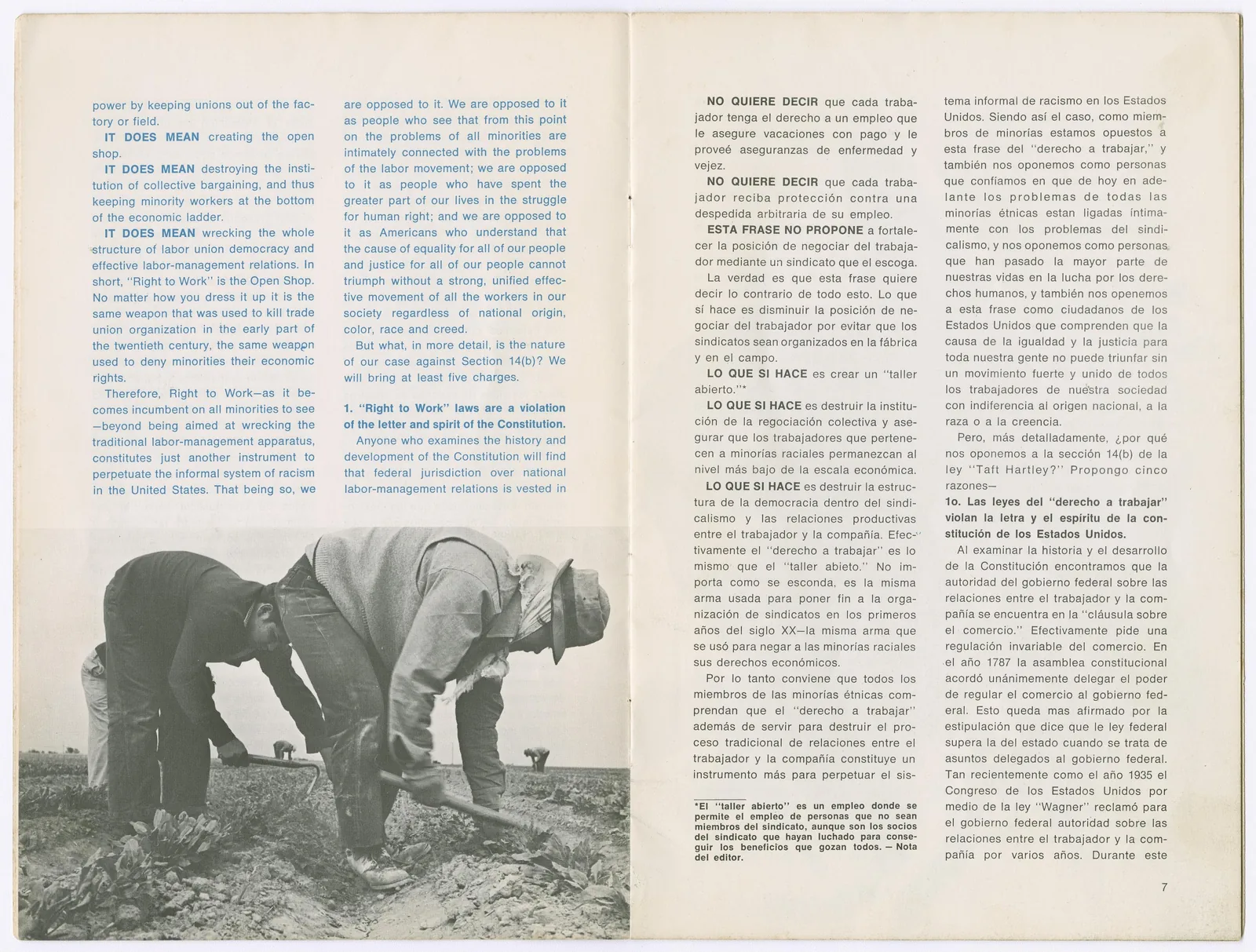
[Photograph, across the foot of the left page and both English columns: two men bent far over a crop row in a flat field, each working with a short-handled hoe, another worker partly visible behind them and two more in the distance. No caption or photo credit is printed.]
[Right page, Spanish column 1:]
NO QUIERE DECIR que cada trabajador tenga el derecho a un empleo que le asegure vacaciones con pago y le proveé aseguranzas de enfermedad y vejez.
NO QUIERE DECIR que cada trabajador reciba protección contra una despedida arbitraria de su empleo.
ESTA FRASE NO PROPONE a fortalecer la posición de negociar del trabajador mediante un sindicato que el escoga.
La verdad es que esta frase quiere decir lo contrario de todo esto. Lo que sí hace es disminuir la posición de negociar del trabajador por evitar que los sindicatos sean organizados en la fábrica y en el campo.
LO QUE SI HACE es crear un "taller abierto."*
LO QUE SI HACE es destruir la institución de la regociación colectiva y asegurar que los trabajadores que pertenecen a minorías raciales permanezcan al nivel más bajo de la escala económica.
LO QUE SI HACE es destruir la estructura de la democracia dentro del sindicalismo y las relaciones productivas entre el trabajador y la compañía. Efectivamente el "derecho a trabajar" es lo mismo que el "taller abierto." No importa como se esconda, es la misma arma usada para poner fin a la organización de sindicatos en los primeros años del siglo XX—la misma arma que se usó para negar a las minorías raciales sus derechos económicos.
Por lo tanto conviene que todos los miembros de las minorías étnicas comprendan que el "derecho a trabajar" además de servir para destruir el proceso tradicional de relaciones entre el trabajador y la compañía constituye un instrumento más para perpetuar el sistema
*El "taller abierto" es un empleo donde se permite el empleo de personas que no sean miembros del sindicato, aunque son los socios del sindicato que hayan luchado para conseguir los beneficios que gozan todos. — Nota del editor.
[Right page, Spanish column 2:]
informal de racismo en los Estados Unidos. Siendo así el caso, como miembros de minorías estamos opuestos a esta frase del "derecho a trabajar," y también nos oponemos como personas que confíamos en que de hoy en adelante los problemas de todas las minorías étnicas estan ligadas íntimamente con los problemas del sindicalismo, y nos oponemos como personas que han pasado la mayor parte de nuestras vidas en la lucha por los derechos humanos, y también nos openemos a esta frase como ciudadanos de los Estados Unidos que comprenden que la causa de la igualdad y la justicia para toda nuestra gente no puede triunfar sin un movimiento fuerte y unido de todos los trabajadores de nuestra sociedad con indiferencia al origen nacional, a la raza o a la creencia.
Pero, más detalladamente, ¿por qué nos oponemos a la sección 14(b) de la ley "Taft Hartley?" Propongo cinco razones—
1o. Las leyes del "derecho a trabajar" violan la letra y el espíritu de la constitución de los Estados Unidos.
Al examinar la historia y el desarrollo de la Constitución encontramos que la autoridad del gobierno federal sobre las relaciones entre el trabajador y la compañía se encuentra en la "cláusula sobre el comercio." Efectivamente pide una regulación invariable del comercio. En el año 1787 la asamblea constitucional acordó unánimemente delegar el poder de regular el comercio al gobierno federal. Esto queda mas afirmado por la estipulación que dice que le ley federal supera la del estado cuando se trata de asuntos delegados al gobierno federal. Tan recientemente como el año 1935 el Congreso de los Estados Unidos por medio de la ley "Wagner" reclamó para el gobierno federal autoridad sobre las relaciones entre el trabajador y la compañía por varios años. Durante este
[Page number: 7]
[Left page, English column 1:]
the "commerce clause," which argues, in effect, for a uniform regulation of commerce. The Constitutional Convention of 1787 voted unanimously to delegate to the federal government the power to regulate commerce. This is further buttressed by the provision that federal law is supreme to state law in areas delegated to the federal government. As recently as 1935, the Congress in the Wagner Act preempted for the federal government jurisdiction over labor management relations for several years, during which the Supreme Court consistently ruled that States may exercise their traditional police powers to protect public safety and order, but may not adopt their own codes of labor relations, since this was the exclusive prerogative of the federal government. The doctrine is clear, and still stands as one of the chief arbiters in relations between the federal government and the States. Significantly, there is just one exception: the authority that Section 14(b) has given the States since 1947 to exercise jurisdiction in matters affecting the local union security. There could be no more flagrant breach of one of the hallowed traditions of the Constitution. Ethnic minorities who have suffered most from the frustration of American constitutional guarantees cannot be happy over yet another blow to their aspirations for social and economic liberation.
President Truman, as many of us recall, had no interest in being an accomplice to this disastrous precedent. He attempted to veto the Taft Hartley Bill, sending it back to Congress with these words:
"The bill is contrary to the national policy of economic freedom . . . would limit the freedom of employers and labor organizations to agree on methods of developing responsibility on the part of unions by establishing union security . . ."
[Page number: 8]
[Left page, English column 2:]
But, as so often happens, Congress saw the issue differently. And so it overrode Truman's veto and destroyed the integrity of labor's hard-won bargaining strength.
2. "Right to Work" laws are undemocratic.
In the 1930's, slowly groping its way out of a disastrous Depression, the country made a momentous democratic political decision: We decided that henceforth free collective bargaining was to be the policy of the nation. We opted to apply democratic principles to the regulation of industrial life, and in doing so, we were also opting for "exclusive jurisdiction" in labor matters. The union that won a free and fair election among the workers in a plant was to be empowered by law to represent all the workers of that plant. The union was to become the exclusive bargaining agent that could exclude or ignore no one. This became the pattern of labor-management relationships, and it helped open the economic doors to hundreds of thousands of minority workers. But comes 1947, and with it Section 14(b) of the Taft Hartley Act. And what does it do? It refuses to acknowledge the binding nature of the majority decision of a union membership, guarantees the right of non-union membership among workers in a plant, imposes the will of a minority of members upon the majority, and thus destroys the collective bargaining arrangement, and slams the door even tighter against the minority worker. But the implication of this so-called right to work law goes beyond the destruction of nationwide trade union democracy; in effect it has also given certain States a minority veto over the federal government, for it permits individual States to walk out on the national labor policy. This is a most unwise and undemocratic turn of events, with grave dangers for
[Handwritten pencil marks in the margin of this column: a long vertical line beside the lines from "political decision: We decided that" to "all the workers of that plant", and a short vertical line with a small mark at the right edge beside "minority worker."]
[Right page:]
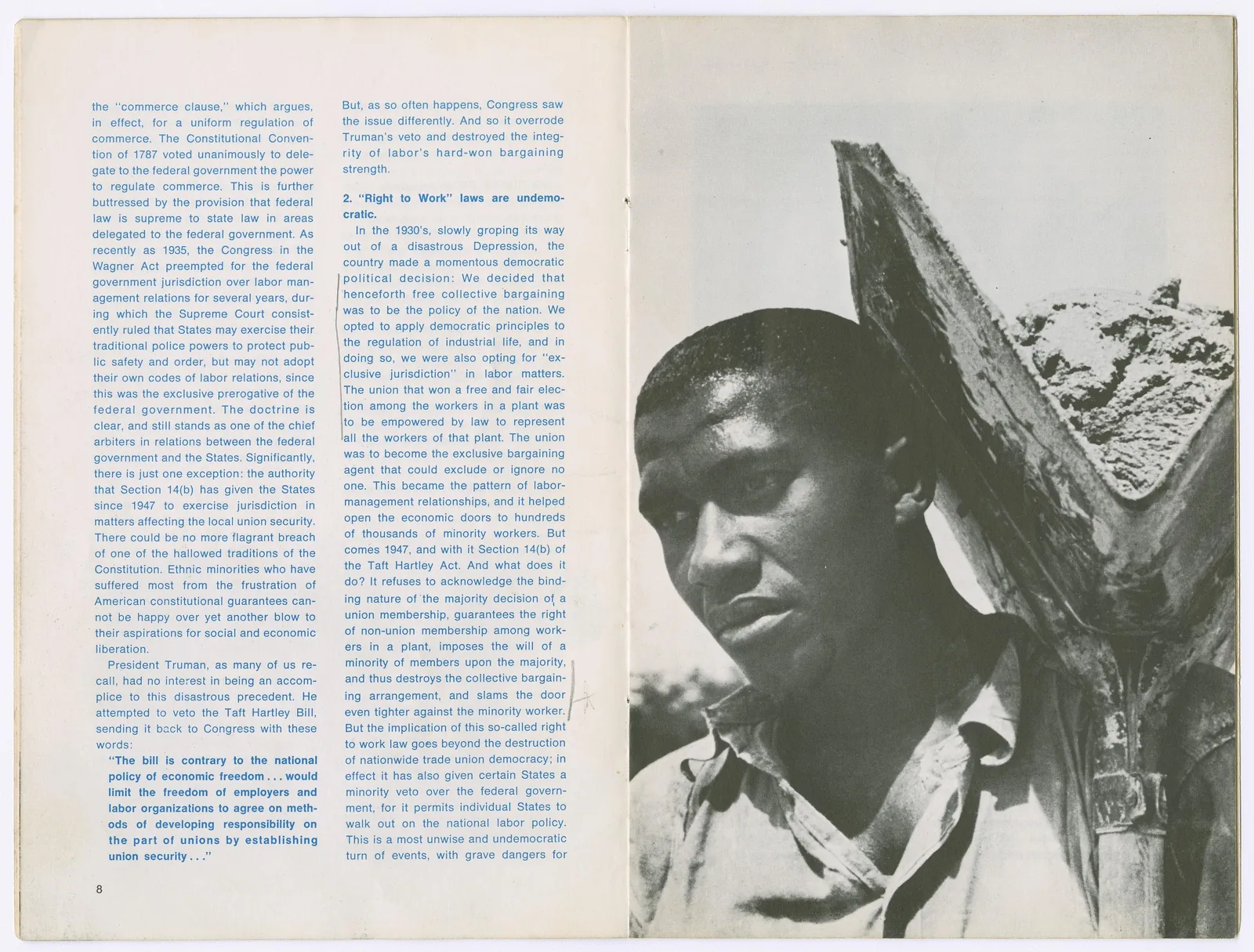
[Photograph filling the whole page: a young Black man, shown from the chest up and looking toward the camera, with a shovel carrying a load of wet mud or concrete resting on his shoulder. No caption, photo credit or page number is printed.]
[Left page, top, across both English columns:]
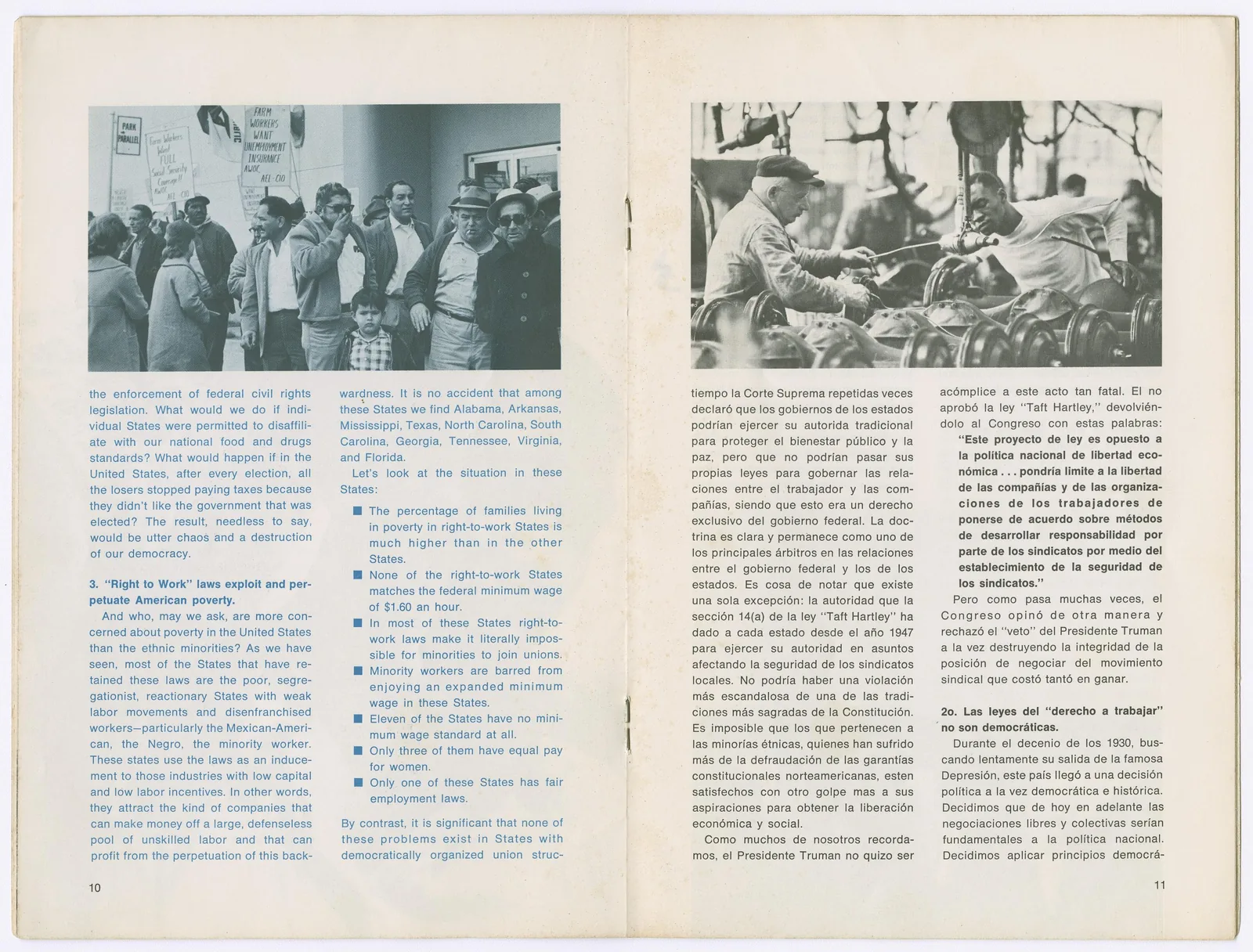
[Photograph: a crowd of men and women, with a small boy in a checked shirt at the front, standing outdoors beside a building. Behind them are picket signs. One hand-lettered sign reads "Farm Workers Want FULL Social Security Coverage!! AWOC AFL-CIO". A second sign reads "FARM WORKERS WANT UNEMPLOYMENT INSURANCE AWOC AFL-CIO". A third sign reads "PARK" above "PARALLEL". A fourth sign behind them is [illegible]. No caption or photo credit is printed.]
[Left page, English column 1:]
the enforcement of federal civil rights legislation. What would we do if individual States were permitted to disaffiliate with our national food and drugs standards? What would happen if in the United States, after every election, all the losers stopped paying taxes because they didn't like the government that was elected? The result, needless to say, would be utter chaos and a destruction of our democracy.
3. "Right to Work" laws exploit and perpetuate American poverty.
And who, may we ask, are more concerned about poverty in the United States than the ethnic minorities? As we have seen, most of the States that have retained these laws are the poor, segregationist, reactionary States with weak labor movements and disenfranchised workers—particularly the Mexican-American, the Negro, the minority worker. These states use the laws as an inducement to those industries with low capital and low labor incentives. In other words, they attract the kind of companies that can make money off a large, defenseless pool of unskilled labor and that can profit from the perpetuation of this backwardness.
[Page number: 10]
[Left page, English column 2:]
It is no accident that among these States we find Alabama, Arkansas, Mississippi, Texas, North Carolina, South Carolina, Georgia, Tennessee, Virginia, and Florida.
Let's look at the situation in these States:
- The percentage of families living in poverty in right-to-work States is much higher than in the other States.
- None of the right-to-work States matches the federal minimum wage of $1.60 an hour.
- In most of these States right-to-work laws make it literally impossible for minorities to join unions.
- Minority workers are barred from enjoying an expanded minimum wage in these States.
- Eleven of the States have no minimum wage standard at all.
- Only three of them have equal pay for women.
- Only one of these States has fair employment laws.
By contrast, it is significant that none of these problems exist in States with democratically organized union struc-
[Right page, top, across both Spanish columns:]
[Photograph: two men at work among rows of large wheel-and-axle assemblies in a factory or railway shop, an older white man in a cap and work jacket on the left and a younger Black man in a long-sleeved white shirt on the right, both reaching toward the machinery, with overhead hoists and chains above them. No caption or photo credit is printed.]
[Right page, Spanish column 1:]
tiempo la Corte Suprema repetidas veces declaró que los gobiernos de los estados podrían ejercer su autorida tradicional para proteger el bienestar público y la paz, pero que no podrían pasar sus propias leyes para gobernar las relaciones entre el trabajador y las compañías, siendo que esto era un derecho exclusivo del gobierno federal. La doctrina es clara y permanece como uno de los principales árbitros en las relaciones entre el gobierno federal y los de los estados. Es cosa de notar que existe una sola excepción: la autoridad que la sección 14(a) de la ley "Taft Hartley" ha dado a cada estado desde el año 1947 para ejercer su autoridad en asuntos afectando la seguridad de los sindicatos locales. No podría haber una violación más escandalosa de una de las tradiciones más sagradas de la Constitución. Es imposible que los que pertenecen a las minorías étnicas, quienes han sufrido más de la defraudación de las garantías constitucionales norteamericanas, esten satisfechos con otro golpe mas a sus aspiraciones para obtener la liberación económica y social.
Como muchos de nosotros recordamos, el Presidente Truman no quizo ser
[Right page, Spanish column 2:]
acómplice a este acto tan fatal. El no aprobó la ley "Taft Hartley," devolviéndolo al Congreso con estas palabras:
"Este proyecto de ley es opuesto a la política nacional de libertad económica . . . pondría limite a la libertad de las compañías y de las organizaciones de los trabajadores de ponerse de acuerdo sobre métodos de desarrollar responsabilidad por parte de los sindicatos por medio del establecimiento de la seguridad de los sindicatos."
Pero como pasa muchas veces, el Congreso opinó de otra manera y rechazó el "veto" del Presidente Truman a la vez destruyendo la integridad de la posición de negociar del movimiento sindical que costó tanto en ganar.
2o. Las leyes del "derecho a trabajar" no son democráticas.
Durante el decenio de los 1930, buscando lentamente su salida de la famosa Depresión, este país llegó a una decisión política a la vez democrática e histórica. Decidimos que de hoy en adelante las negociaciones libres y colectivas serían fundamentales a la política nacional. Decidimos aplicar principios democrá-
[Page number: 11]
[Left page, English, first column:]
tures. Twenty-three of the States without "Right to Work" laws do have enforceable minimum wage laws. Fourteen of them cover men as well as women. Twenty-one provide at least $1.00 an hour minimum wage. And twelve of them equal or exceed the federal minimum wage of $1.60 an hour. And in all of them minority workers are organized in the union shop structure.
So, as the evidence shows, contrary to guaranteeing the right to work, what these laws do is to guarantee the right to work long hours; the right to discriminate; the right to underpay women who do equal work with men; the right to pay substandard wages; the right to pay substandard unemployment compensation benefits; and the right to destroy organized unionism.
4. "Right to Work" laws are aimed at civil rights, job rights.
It does not require an extraordinary amount of wisdom to see that behind the
[Left page, English, second column:]
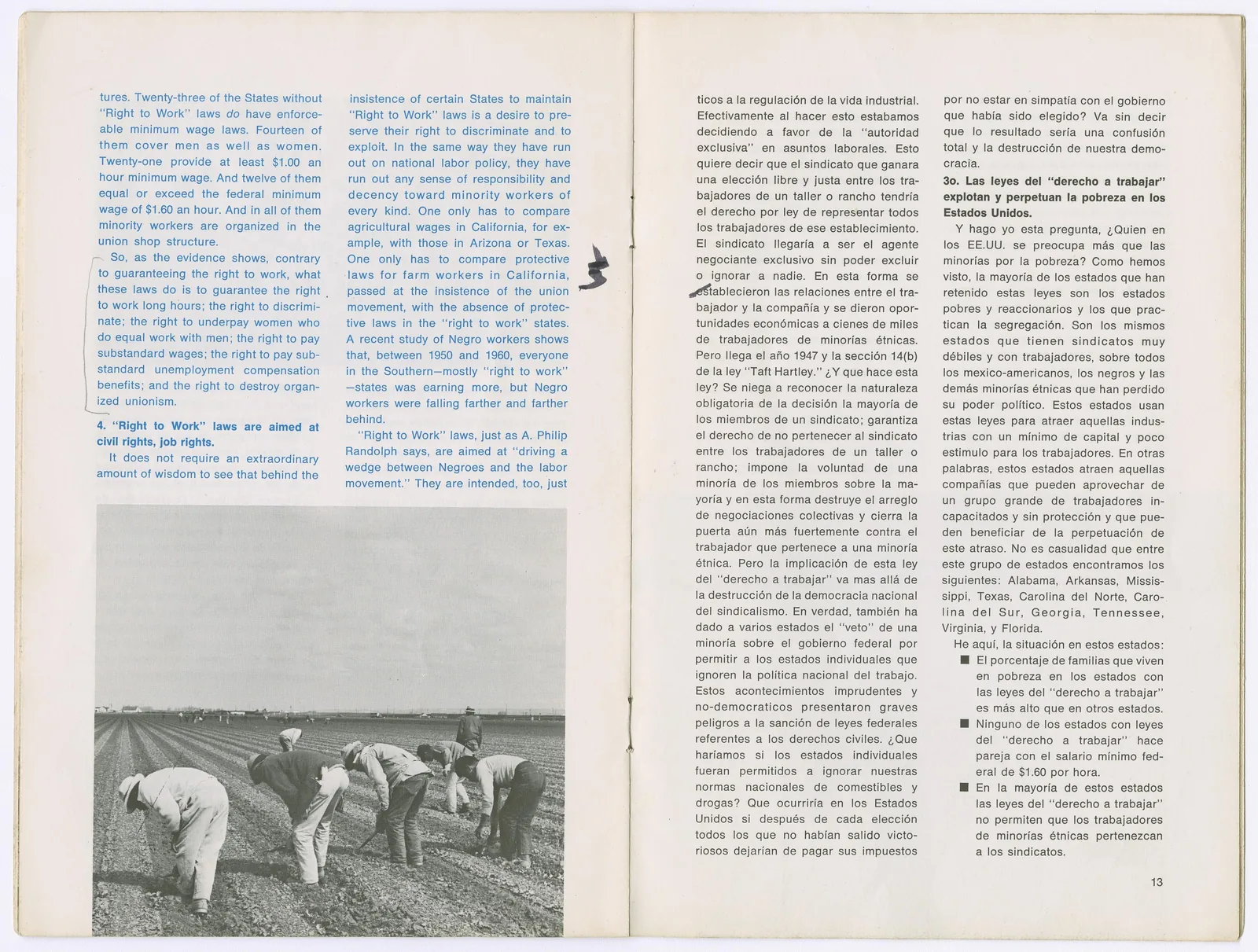
insistence of certain States to maintain "Right to Work" laws is a desire to preserve their right to discriminate and to exploit. In the same way they have run out on national labor policy, they have run out any sense of responsibility and decency toward minority workers of every kind. One only has to compare agricultural wages in California, for example, with those in Arizona or Texas. One only has to compare protective laws for farm workers in California, passed at the insistence of the union movement, with the absence of protective laws in the "right to work" states. A recent study of Negro workers shows that, between 1950 and 1960, everyone in the Southern—mostly "right to work"—states was earning more, but Negro workers were falling farther and farther behind.
"Right to Work" laws, just as A. Philip Randolph says, are aimed at "driving a wedge between Negroes and the labor movement." They are intended, too, just
[Left page, below the text: a black-and-white photograph spanning the width of both columns, showing a row of farmworkers in hats and work clothes bending over to work in a plowed field under an open sky. No caption or credit is printed.]
[Right page, Spanish, first column:]
ticos a la regulación de la vida industrial. Efectivamente al hacer esto estabamos decidiendo a favor de la "autoridad exclusiva" en asuntos laborales. Esto quiere decir que el sindicato que ganara una elección libre y justa entre los trabajadores de un taller o rancho tendría el derecho por ley de representar todos los trabajadores de ese establecimiento. El sindicato llegaría a ser el agente negociante exclusivo sin poder excluir o ignorar a nadie. En esta forma se establecieron las relaciones entre el trabajador y la compañía y se dieron oportunidades económicas a cienes de miles de trabajadores de minorías étnicas. Pero llega el año 1947 y la sección 14(b) de la ley "Taft Hartley." ¿Y que hace esta ley? Se niega a reconocer la naturaleza obligatoria de la decisión la mayoría de los miembros de un sindicato; garantiza el derecho de no pertenecer al sindicato entre los trabajadores de un taller o rancho; impone la voluntad de una minoría de los miembros sobre la mayoría y en esta forma destruye el arreglo de negociaciones colectivas y cierra la puerta aún más fuertemente contra el trabajador que pertenece a una minoría étnica. Pero la implicación de esta ley del "derecho a trabajar" va mas allá de la destrucción de la democracia nacional del sindicalismo. En verdad, también ha dado a varios estados el "veto" de una minoría sobre el gobierno federal por permitir a los estados individuales que ignoren la política nacional del trabajo. Estos acontecimientos imprudentes y no-democraticos presentaron graves peligros a la sanción de leyes federales referentes a los derechos civiles. ¿Que haríamos si los estados individuales fueran permitidos a ignorar nuestras normas nacionales de comestibles y drogas? Que ocurriría en los Estados Unidos si después de cada elección todos los que no habían salido victoriosos dejarían de pagar sus impuestos
[Right page, Spanish, second column:]
por no estar en simpatía con el gobierno que había sido elegido? Va sin decir que lo resultado sería una confusión total y la destrucción de nuestra democracia.
3o. Las leyes del "derecho a trabajar" explotan y perpetuan la pobreza en los Estados Unidos.
Y hago yo esta pregunta, ¿Quien en los EE.UU. se preocupa más que las minorías por la pobreza? Como hemos visto, la mayoría de los estados que han retenido estas leyes son los estados pobres y reaccionarios y los que practican la segregación. Son los mismos estados que tienen sindicatos muy débiles y con trabajadores, sobre todos los mexico-americanos, los negros y las demás minorías étnicas que han perdido su poder político. Estos estados usan estas leyes para atraer aquellas industrias con un mínimo de capital y poco estimulo para los trabajadores. En otras palabras, estos estados atraen aquellas compañías que pueden aprovechar de un grupo grande de trabajadores incapacitados y sin protección y que pueden beneficiar de la perpetuación de este atraso. No es casualidad que entre este grupo de estados encontramos los siguientes: Alabama, Arkansas, Mississippi, Texas, Carolina del Norte, Carolina del Sur, Georgia, Tennessee, Virginia, y Florida.
He aquí, la situación en estos estados:
- El porcentaje de familias que viven en pobreza en los estados con las leyes del "derecho a trabajar" es más alto que en otros estados.
- Ninguno de los estados con leyes del "derecho a trabajar" hace pareja con el salario mínimo federal de $1.60 por hora.
- En la mayoría de estos estados las leyes del "derecho a trabajar" no permiten que los trabajadores de minorías étnicas pertenezcan a los sindicatos.
[Page number: 13]
[Handwritten marks: a pencil bracket in the left margin beside the paragraph beginning "So, as the evidence shows"; a dark pen mark in the gutter of the right page and a pencil tick in the margin beside "establecieron".]
[Left page, English, first column:]
as much to drive a wedge between the Mexican-American, the Filipino, the Puerto Rican worker, and the union movement—to keep the minority workers even weaker, even more helpless. "Right to Work" laws, as Martin Luther King said, rob all minority workers of their civil rights and job rights. It is significant that the worst exploiters of labor are often the staunchest enemies of civil rights and job rights.
5. "Right to Work" laws are "hate" laws.
Who are some of the leading figures behind the drive to retain "Right to Work" laws? You will find their names on every right-wing letterhead across the nation, all of which organizations, let us not forget, are anti-Negro, anti-Mexican American, and anti-Puerto Rican, and anti-civil rights. These men and organizations who are representatives on the Right to Work Committee are well-known right-wingers.
[Left page, English, second column:]
What could it be that has suddenly united racists and rightists, industrialists and corporation farmers behind the right to work? We wonder why it is that these laws were being passed in Alabama, Mississippi, Arkansas, North Carolina, South Carolina and Texas during the late forties and early fifties, precisely the times when minority workers—the Negro as well as the Mexican-American—were effectively denied the right to vote? Isn't it rather cheerful and hopeful for the future of our democracy that members of the John Birch Society have suddenly developed a tender love and sympathy for the common man? If questions like these bring sneers instead of smiles to our faces, then we know we cannot take them seriously, that we are in fact being had.
In raising these questions, we are not supporting the notion of guilt by association. We are against lists that would bar a man from a job on the grounds of
[Right page, Spanish, first column:]
- En estos estados los trabajadores de minorías étnicas son impedidos de participar en el creciente salario mínimo.
- De todos estos estados once carecen de alguna norma de salario mínimo.
- Solamente tres de estos estados tienen sueldos iguales para las mujeres.
- Solamente uno de estos estados tiene leyes de justicia en el empleo.
En comparación es importante notar que estos problemas no existen en los estados que tienen sindicatos organizados en forma democrática. De los estados que no tienen las leyes del "derecho a trabajar," 23 tienen leyes ejecutables de sueldo mínimo. Y de estos, 14 aplican la misma ley de salario mínimo a mujeres como a hombres. Veintiuno de estos estados proveen por
[Right page, Spanish, second column:]
lo menos un dólar por hora como salario mínimo. Doce de estos estados tienen o superan al salario mínimo federal de $1.60 por hora. Y en todos estos estados trabajadores de minorías étnicas se encuentran en la estructura del sindicato.
Así es que según la evidencia en vez de garantizar el derecho a trabajar estas leyes garantizan el derecho a trabajar horas largas, el derecho a discriminar, el derecho a pagar menos a las mujeres que hacen el mismo trabajo que los hombres, el derecho a pagar un salario sub-normal, el derecho de pagar beneficios de desempleo o de compensación sub-normal y el derecho a destruir el sindicalismo organizado.
4o. Las leyes del "derecho a trabajar" son dirigidas en contra de los derechos civiles y de los derechos de los trabajadores.
No requiere mucho reconocer que la
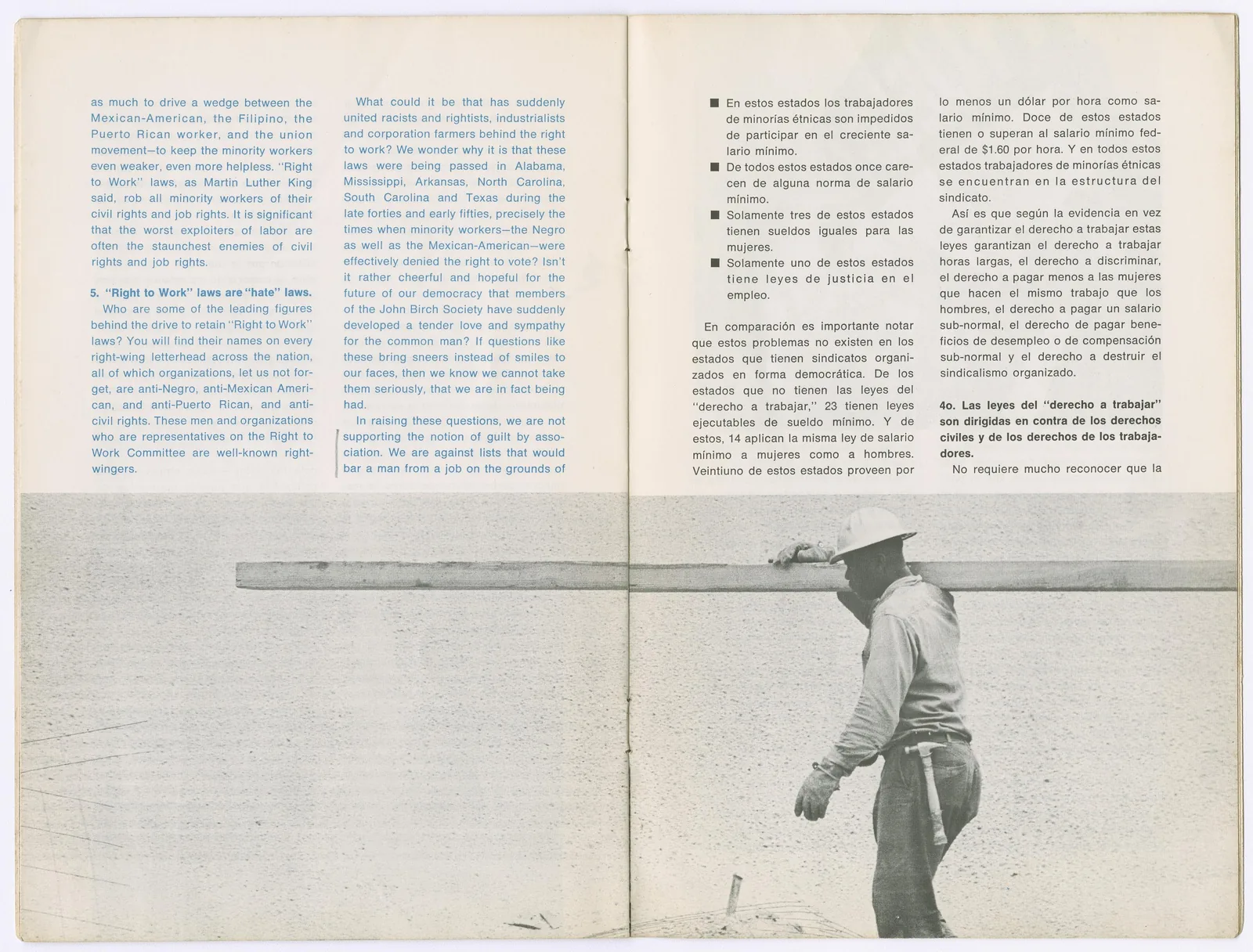
[Photograph across the bottom of both pages: a black-and-white photograph of a construction worker in a hard hat and work gloves, a hammer hanging at his belt, carrying a long wooden beam across his shoulders against a plain, textured background. No caption or credit is printed.]
[Handwritten mark: a pencil vertical line in the left margin of the second English column, beside "supporting the notion of guilt by association."]
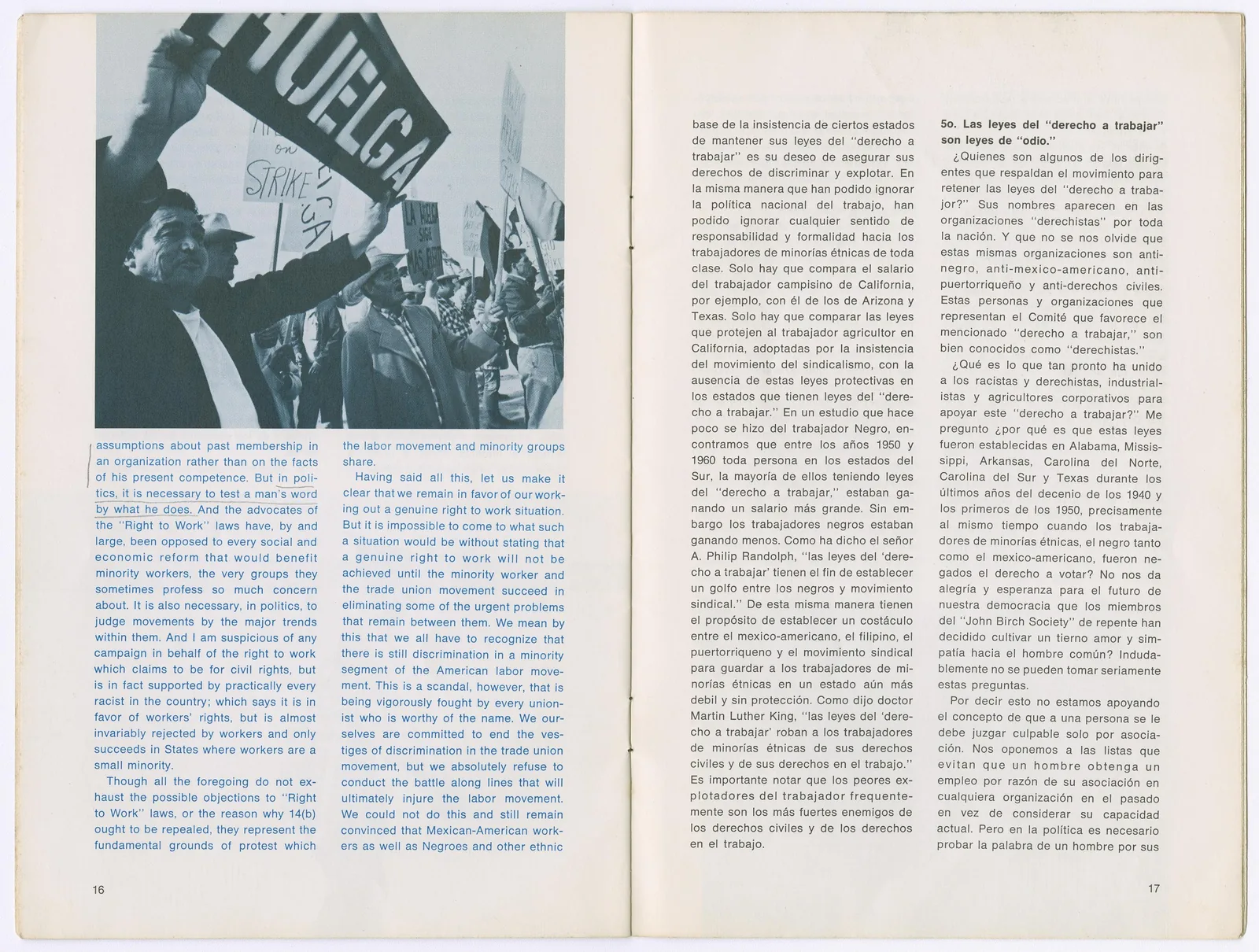
[Left page, top: a black-and-white photograph tinted blue, showing a man in the foreground raising a black sign with the word "HUELGA" above a crowd of men in hats and coats carrying picket signs, among them "on STRIKE" and "LA HUELGA SIGUE MAS [illegible]". No caption or credit is printed.]
[Left page, English, first column:]
assumptions about past membership in an organization rather than on the facts of his present competence. But in politics, it is necessary to test a man's word by what he does. And the advocates of the "Right to Work" laws have, by and large, been opposed to every social and economic reform that would benefit minority workers, the very groups they sometimes profess so much concern about. It is also necessary, in politics, to judge movements by the major trends within them. And I am suspicious of any campaign in behalf of the right to work which claims to be for civil rights, but is in fact supported by practically every racist in the country; which says it is in favor of workers' rights, but is almost invariably rejected by workers and only succeeds in States where workers are a small minority.
Though all the foregoing do not exhaust the possible objections to "Right to Work" laws, or the reason why 14(b) ought to be repealed, they represent the fundamental grounds of protest which
[Left page, English, second column:]
the labor movement and minority groups share.
Having said all this, let us make it clear that we remain in favor of our working out a genuine right to work situation. But it is impossible to come to what such a situation would be without stating that a genuine right to work will not be achieved until the minority worker and the trade union movement succeed in eliminating some of the urgent problems that remain between them. We mean by this that we all have to recognize that there is still discrimination in a minority segment of the American labor movement. This is a scandal, however, that is being vigorously fought by every unionist who is worthy of the name. We ourselves are committed to end the vestiges of discrimination in the trade union movement, but we absolutely refuse to conduct the battle along lines that will ultimately injure the labor movement. We could not do this and still remain convinced that Mexican-American workers as well as Negroes and other ethnic
[Page number: 16]
[Right page, Spanish, first column:]
base de la insistencia de ciertos estados de mantener sus leyes del "derecho a trabajar" es su deseo de asegurar sus derechos de discriminar y explotar. En la misma manera que han podido ignorar la política nacional del trabajo, han podido ignorar cualquier sentido de responsabilidad y formalidad hacia los trabajadores de minorías étnicas de toda clase. Solo hay que compara el salario del trabajador campisino de California, por ejemplo, con él de los de Arizona y Texas. Solo hay que comparar las leyes que protejen al trabajador agricultor en California, adoptadas por la insistencia del movimiento del sindicalismo, con la ausencia de estas leyes protectivas en los estados que tienen leyes del "derecho a trabajar." En un estudio que hace poco se hizo del trabajador Negro, encontramos que entre los años 1950 y 1960 toda persona en los estados del Sur, la mayoría de ellos teniendo leyes del "derecho a trabajar," estaban ganando un salario más grande. Sin embargo los trabajadores negros estaban ganando menos. Como ha dicho el señor A. Philip Randolph, "las leyes del 'derecho a trabajar' tienen el fin de establecer un golfo entre los negros y movimiento sindical." De esta misma manera tienen el propósito de establecer un costáculo entre el mexico-americano, el filipino, el puertorriqueno y el movimiento sindical para guardar a los trabajadores de minorías étnicas en un estado aún más debil y sin protección. Como dijo doctor Martin Luther King, "las leyes del 'derecho a trabajar' roban a los trabajadores de minorías étnicas de sus derechos civiles y de sus derechos en el trabajo." Es importante notar que los peores explotadores del trabajador frecuentemente son los más fuertes enemigos de los derechos civiles y de los derechos en el trabajo.
[Right page, Spanish, second column:]
5o. Las leyes del "derecho a trabajar" son leyes de "odio."
¿Quienes son algunos de los dirigentes que respaldan el movimiento para retener las leyes del "derecho a trabajor?" Sus nombres aparecen en las organizaciones "derechistas" por toda la nación. Y que no se nos olvide que estas mismas organizaciones son anti-negro, anti-mexico-americano, anti-puertorriqueño y anti-derechos civiles. Estas personas y organizaciones que representan el Comité que favorece el mencionado "derecho a trabajar," son bien conocidos como "derechistas."
¿Qué es lo que tan pronto ha unido a los racistas y derechistas, industrialistas y agricultores corporativos para apoyar este "derecho a trabajar?" Me pregunto ¿por qué es que estas leyes fueron establecidas en Alabama, Mississippi, Arkansas, Carolina del Norte, Carolina del Sur y Texas durante los últimos años del decenio de los 1940 y los primeros de los 1950, precisamente al mismo tiempo cuando los trabajadores de minorías étnicas, el negro tanto como el mexico-americano, fueron negados el derecho a votar? No nos da alegría y esperanza para el futuro de nuestra democracia que los miembros del "John Birch Society" de repente han decidido cultivar un tierno amor y simpatía hacia el hombre común? Indudablemente no se pueden tomar seriamente estas preguntas.
Por decir esto no estamos apoyando el concepto de que a una persona se le debe juzgar culpable solo por asociación. Nos oponemos a las listas que evitan que un hombre obtenga un empleo por razón de su asociación en cualquiera organización en el pasado en vez de considerar su capacidad actual. Pero en la política es necesario probar la palabra de un hombre por sus
[Page number: 17]
[Handwritten marks: a pencil vertical line in the left margin beside the first lines of the left page, and pencil underlining beneath "in politics, it is necessary to test a man's word by what he does."]
[Left page, English, first column:]
groups have a need and a responsibility to make that movement stronger and more effective.
After all, we must recognize that much of the economic progress of minority workers—of the Mexican-American, the Negro, the Filipino and Puerto Rican alike—stems from their membership in or their support by the labor movement. When the Mexican American came north soon after World War I, in search of jobs and dignity, we know what he found. He found an economy that was systematically arranged to keep him unemployed for long intervals, to pay him low wages for inhumanly long hours during the short, hectic periods when he worked, to fire him and return him quickly to the pool of unemployed when the harvest was in or the job done. We know that the Depression sent hundreds of thousands back to Mexico, from the frying pan of unemployment to the fire of sheer poverty. It was in the years after that, for the first time, the Mexican-American tasted the fruits of union organization. In California, for instance, the farm workers organized—not only the Mexican-American, but the Filipino, the "Okies" and the "Arkies," the Negroes who worked those fertile valleys. Those tentative, groping unions were finally smashed, under the growers' open shop policies—the very embodiment of what soon came to be called "right to work." Now, once more, farm workers are unionizing, once again with the support and backing of the labor movement. Once more, and brighter than ever, the road to dignity and decent living is open. And the trade unions held out the helping hand that made it possible. There are still many problems to be solved between the minority worker and the labor movement; however, we are pressing a vigorous attack upon these problems. Already the labor movement is one of the most
[Page number: 18]
[Left page, English, second column:]
integrated institutions in our society—more integrated than our schools, our churches and our industry. And the recent Bal Harbour resolution of the Building Trades Council of the AFL-CIO promises to wage an all-out attack upon the last vestiges of discrimination in the trade union movement.
When we urge an alliance between the labor movement and other minority groups, we are not encouraging complacency nor losing sight of the unfinished business. We simply want to place the relation of the minority worker to the white worker in proper perspective. More than that, it is to help us to confront together a new injustice: What are the millions of impoverished workers of every color and creed and origin going to do in an age of automation? How can we, in the new developing circumstances, guarantee full employment, and therefore guarantee a genuine right to work? The only way to guarantee this kind of right to work is for minority workers and the unions to work together. We cannot do it by ourselves, and the economy cannot do it without us. We both have got to weld a great coalition to solve the problems of jobs, education, housing. We have got to make our movement come to represent the majority will of the American society and help it move on to massive and planned social investments to end slums, inferior schools, and depression rates of employment.
It is only when we have achieved all this that we will have achieved the genuine right to work. In closing, then, we are in favor of the right to work in the sense that Franklin Roosevelt was: namely, that this society should guarantee every worker a job at decent wages with security and dignity; and if the private sector does not fulfill this task, then it must be the automatic, legal obligation of the public sector to do so.
[Right page, Spanish, first column:]
hechos. Y los defensores de las leyes del "derecho a trabajar" generalmente se han opuesto a toda reforma social y económica que pudiera beneficiar al trabajador de las minorías étnicas, los mismos por los cuales muchas veces expresan su preocupación. También en la política es necesario juzgar los movimientos por las inclinaciones principales que llevan. Sospechamos a cualquiera campaña a favor del derecho a trabajar que profesa estar a favor de los derechos civiles y a la vez tiene el apoyo de toda racista del país; que dice que esta a favor de los derechos del trabajador pero que casi siempre es rechazada por los trabajadores; y que solo tiene éxito en los estados donde hay muy pocos trabajadores.
Aunque lo anterior dicho no agota las oposiciones posibles a las leyes del "derecho a trabajar" o la razón por la cual la sección 14(b) de la ley "Taft Hartley" debe ser revocada, representa la base de la oposicion en la que se ven unidas el movimiento del obrerismo y los grupos de minorías étnicas.
Habiendo dicho esto queremos dejar la impresión clara de que favorecemos la solución verdadera de la situación del derecho a trabajar. Pero sería imposible
[Right page, Spanish, second column:]
llegar a tal situación hasta que el trabajador de minoría étnica y el sindicalismo eliminen algunos de los problemas urgentes que permanecen entre ellos. Lo que queremos decir es que tenemos que reconocer que aún existe la discriminacion en un grupo mínimo del movimiento del obrerismo en los Estados Unidos. Esto es un escándalo que cada sindicalista que es digno de llevar el nombre esta tratando vigorosamente de eliminar. Personalmente estamos dedicados a poner fin a las trazas de la discriminación en el sindicalismo pero nos negamos a llevar esta batalla en una forma que perjudique el movimiento del obrerismo. No pudieramos hacer esto y seguir en nuestra convicción de que el trabajador méxico-americano y negro y él de otros grupos étnicos tiene la necesidad y la responsibilidad de fortalecer este movimiento y hacerlo más eficaz.
Sobre todo debemos reconocer que mucho del progreso económico del trabajador de minoría étnica—el méxico-americano, el negro, el filipino, y el puertorriqueño nace de su asociación con el movimiento del obrerismo o el apoyo que recibe de este movimiento. Cuando el méxico-americano emigró al
[Right page, bottom: a black-and-white photograph of a man in profile, facing right and speaking toward a microphone, wearing a checked collared shirt and a dark jacket; part of a lace or embroidered cloth is visible behind him on the right. No caption or credit is printed.]
[Handwritten/physical marks: a faint vertical pencil line or crease in the right margin of the second English column, beside "work? The only way to guarantee this kind of right to work".]
[Left page, Spanish, first column:]
Norte después de a primera guerra mundial buscando empleo y dignidad ya sabemos que es lo que encontró. Encontró una economía formada sistemáticamente para guarda lo sin empleo por temporadas largas, para pagarle un salario bajo por las largas e inhumanas horas durante las temporadas cortas y hécticas cuando si trabajaba, y para despedirlo de su empleo al terminar la cosechao la obra y devolverio al grupo de trabajadores sin empleo. Sabemos que la Depresión del decenio de los 1930 causó que cienes de miles regresaran a México—del sufrimiento de estar sin empleo al abismo de pobreza completa. Fué en los años siguientes que el méxico-americano por primera vez vió los frutos de sindicalismo organizado. Por ejemplo en California el trabajador campesino se organizó. No solamente el méxico-americano sinó también el filipino, él de Oklahoma y de Arkansas y el negro—todos que cultivaron esas tierras fructuosas. Bajo la política de "taller abierto" de las compañías esos sindicatos tentativos fueron destruidos. Esta política del "taller abierto" fué la composición de lo que llegó a ser llamado el "derecho a trabajar." Ahora una vez más los trabajadores campesinos se estan organizando en sindicatos con el apoyo y sostén del movimiento del obrerismo. Una vez más y con aún más esperanza está abierto el camino hacia la dignidad y una manera de vivir decentemente. Los sindicatos han extendido la mano y el apoyo que lo hizo posible. Todavía existen muchos problemas que hay para resolver entre el trabajador de minoría étnica y el movimiento del obrerismo, pero esto no obstante estamos trabajando vigurosamente para resolverlos. Nosotros personalmente estamos haciendo lo posible para colocar a jovenes negros y puertorriqueños en la construcción, y hemos tenido éxito en consequir empleo para 250 jovenes en
[Page number: 20]
[Left page, Spanish, second column:]
Nueva York. Cuando urgemos una alianza entre el movimiento sindical y otros grupos de urgemos minorías no estamos haciendolo para fomentar satisfacción en si mismo ni estamos perdiendo la vista de lo que nos falta cumplir. Solamente queremos poner la relación del trabajador de minoría étnica al anglo en su lugar propio. Pero más que esto es para ayudarnos enfrentar una nueva injusticia. ¿Que van a hacer los millones de trabajadores empobrecidos de todo color, raza u origen nacional cuando llega la automación? Bajo estas nuevas circumstancias como podemos nosotros garantizarles el empleo total y en esta manera garantizarles el verdadero derecho a trabajar? La única manera de garantizarselos es que los trabajadores de las minorías étnicas y los sindicatos se unan para trabajar juntos. Esto no lo podemos hacer solos y la economía no lo puede realizar sin nosotros. Ambos tenemos que formar una alianza para resolver los problemas de desempleo, de la educación y del alojamiento. Tenemos que hacer que nuestro movimiento llegue a representar la voluntad de la mayoría de la sociedad en los Estados Unidos y ayudar a esta sociedad para que haga inversiones sociales substanciales para terminar con los barrios, las escuelas inferiores y niveles de empleo característicos de los años de la Depresión.
Solamente cuando realizemos todo esto habríamos realizado el verdadero derecho a trabajar. Para terminar quisieramos decir que favorecemos el derecho a trabajar en el mismo sentido que lo hacía el Presidente Franklin Roosevelt: es decir que esta sociedad debería garantizar un empleo decente a cada trabajador con un salario decente y con seguridad y dignidad. Si los negociantes no cumplen con este deber queda la obligación automáticamente y legalmente con el gobierno.
[Right page, top, two author notes side by side:]
Bayard Rustin
is Executive Director of the A. Philip Randolph Institute.
Cesar E. Chavez
is Director of the United Farm Workers, AFL-CIO.
Design by Eugene Glaberman
Quantity prices upon request
Clip and send to
[Right page, order form in a dashed blue border:]
Additional copies may be ordered from:
A. Philip Randolph Institute
217 West 125th Street, New York, N. Y. 10027
Telephone: 212 666-9510
or from
United Farm Workers, AFL-CIO
Box 130
Delano, California 93215
[Checkbox] Please send me..........copies of "Right to Work" Laws
[Checkbox] Please add my name to your mailing list
Name [blank line]
Address [blank line]
City [blank line] State [blank line] Zip Code [blank line]