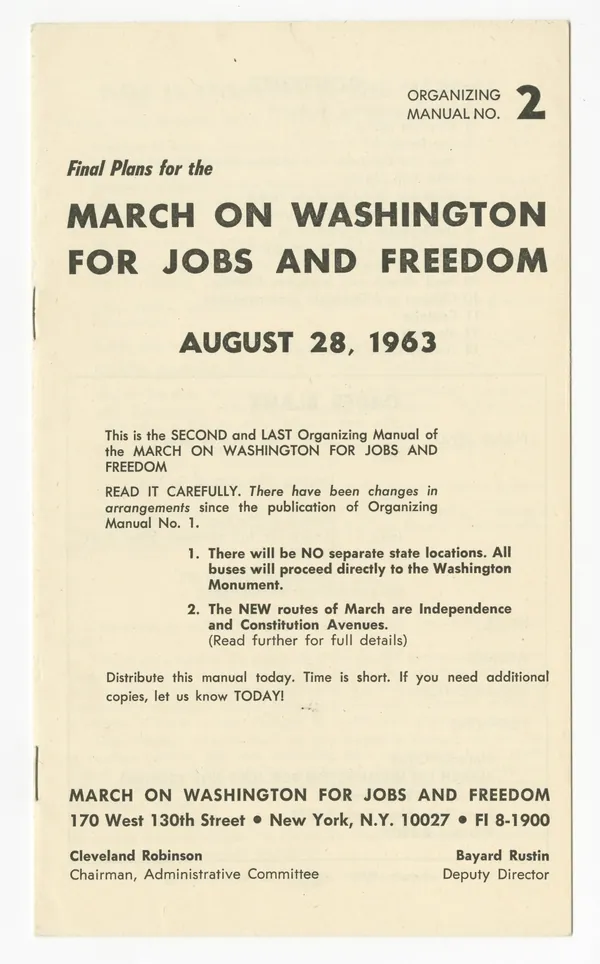
March on Washington Program
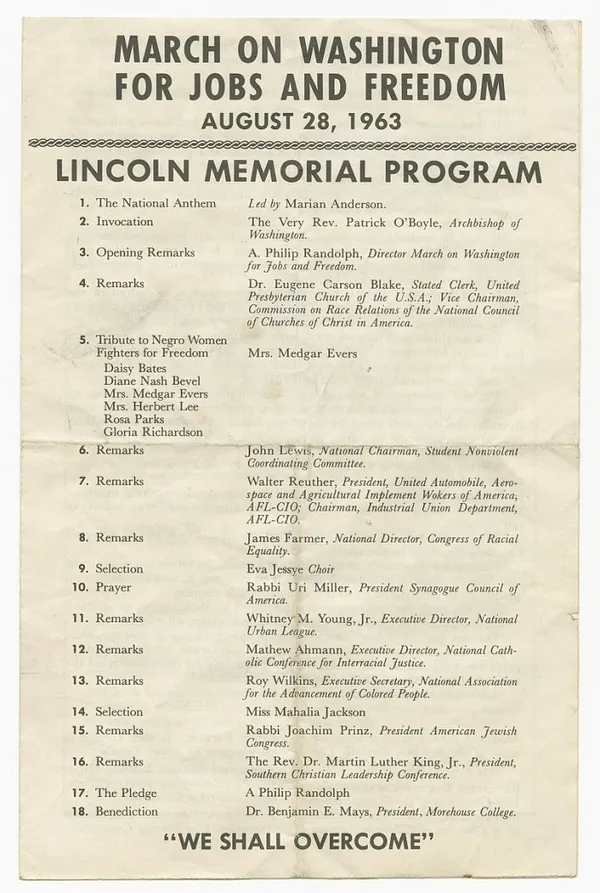
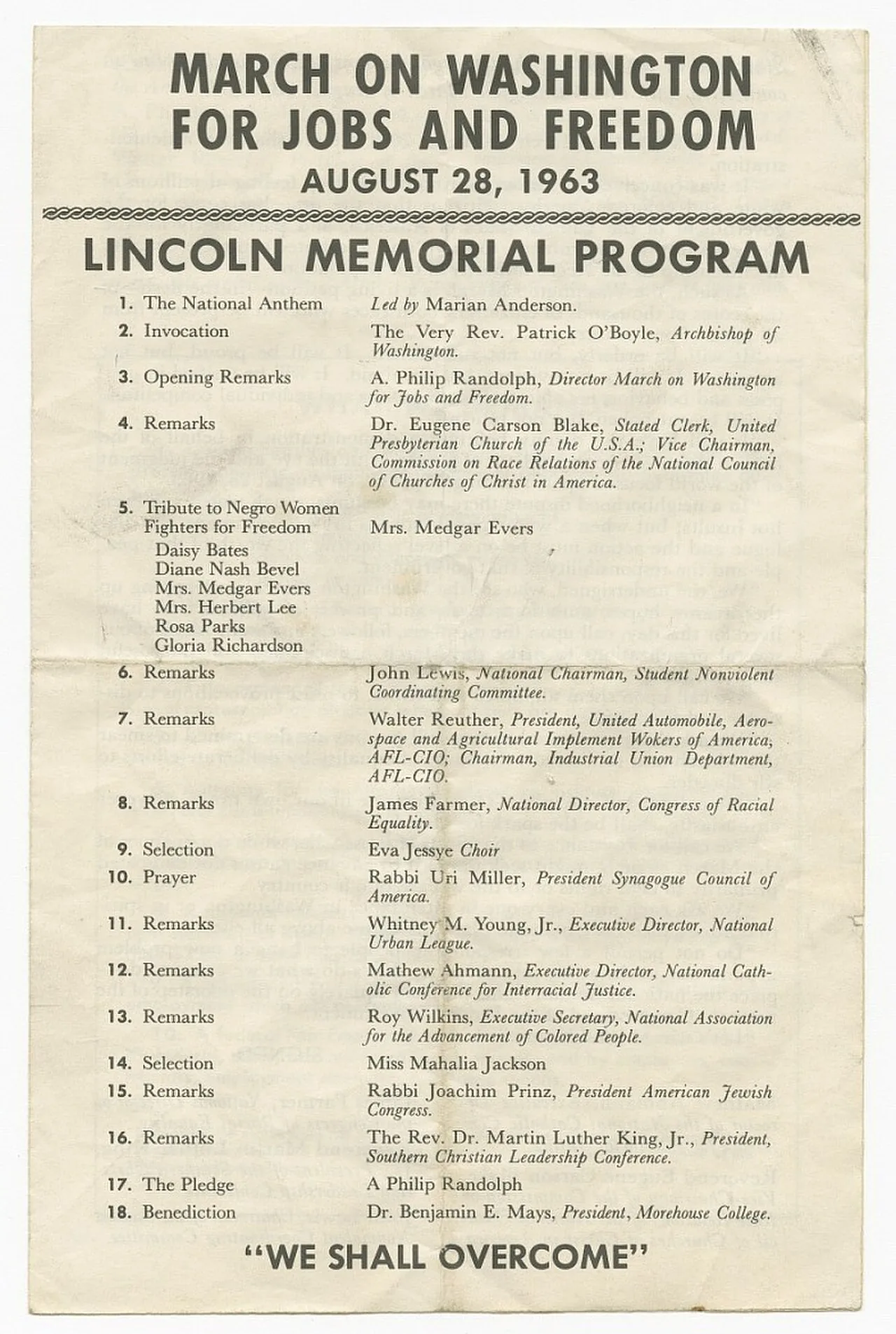
MARCH ON WASHINGTON FOR JOBS AND FREEDOM
AUGUST 28, 1963
LINCOLN MEMORIAL PROGRAM
1. The National Anthem — Led by Marian Anderson.
2. Invocation — The Very Rev. Patrick O'Boyle, Archbishop of Washington.
3. Opening Remarks — A. Philip Randolph, Director March on Washington for Jobs and Freedom.
4. Remarks — Dr. Eugene Carson Blake, Stated Clerk, United Presbyterian Church of the U.S.A.; Vice Chairman, Commission on Race Relations of the National Council of Churches of Christ in America.
5. Tribute to Negro Women Fighters for Freedom — Mrs. Medgar Evers
Daisy Bates
Diane Nash Bevel
Mrs. Medgar Evers
Mrs. Herbert Lee
Rosa Parks
Gloria Richardson
6. Remarks — John Lewis, National Chairman, Student Nonviolent Coordinating Committee.
7. Remarks — Walter Reuther, President, United Automobile, Aerospace and Agricultural Implement Wokers of America, AFL-CIO; Chairman, Industrial Union Department, AFL-CIO.
8. Remarks — James Farmer, National Director, Congress of Racial Equality.
9. Selection — Eva Jessye Choir
10. Prayer — Rabbi Uri Miller, President Synagogue Council of America.
11. Remarks — Whitney M. Young, Jr., Executive Director, National Urban League.
12. Remarks — Mathew Ahmann, Executive Director, National Catholic Conference for Interracial Justice.
13. Remarks — Roy Wilkins, Executive Secretary, National Association for the Advancement of Colored People.
14. Selection — Miss Mahalia Jackson
15. Remarks — Rabbi Joachim Prinz, President American Jewish Congress.
16. Remarks — The Rev. Dr. Martin Luther King, Jr., President, Southern Christian Leadership Conference.
17. The Pledge — A Philip Randolph
18. Benediction — Dr. Benjamin E. Mays, President, Morehouse College.
"WE SHALL OVERCOME"
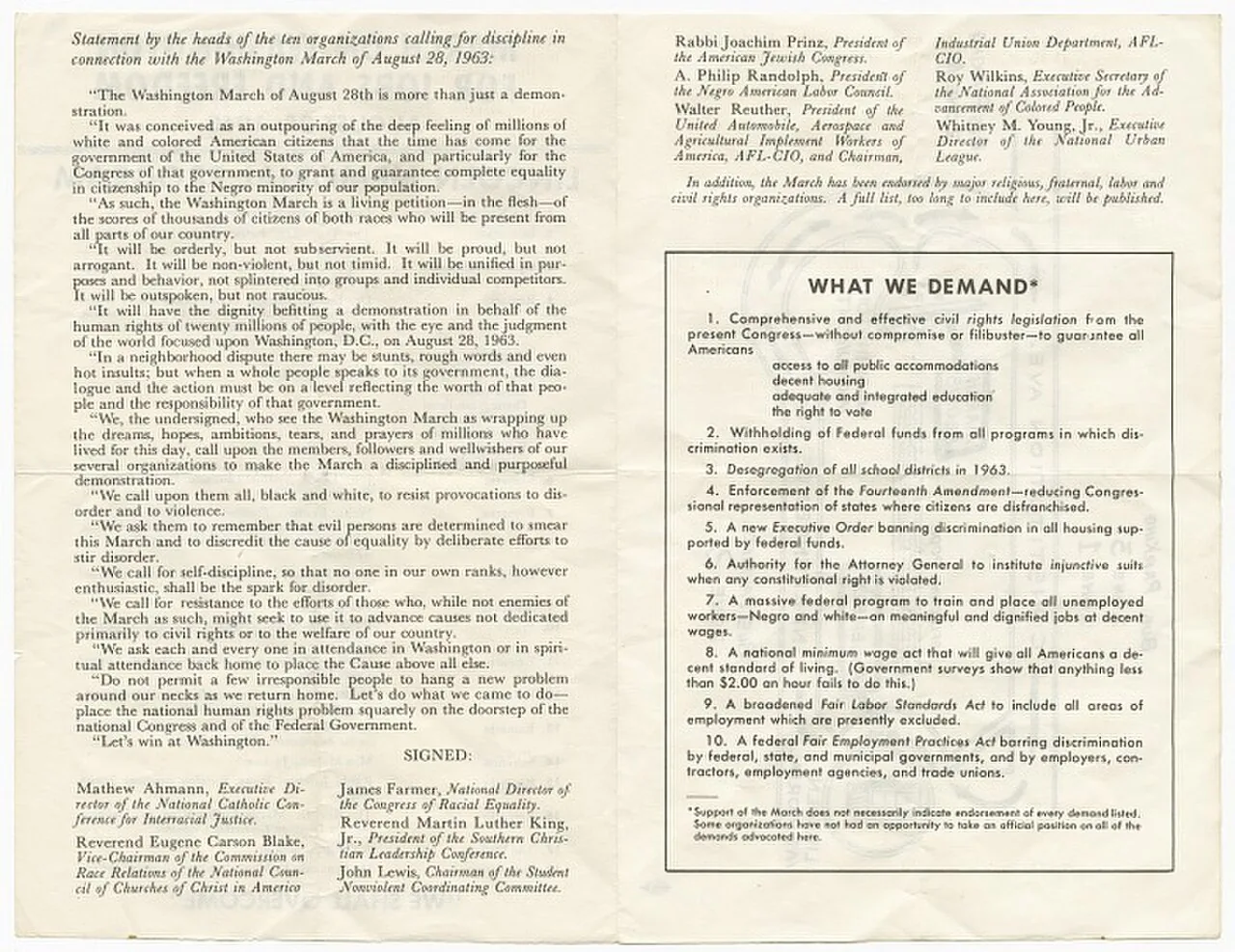
Statement by the heads of the ten organizations calling for discipline in connection with the Washington March of August 28, 1963:
"The Washington March of August 28th is more than just a demonstration.
"It was conceived as an outpouring of the deep feeling of millions of white and colored American citizens that the time has come for the government of the United States of America, and particularly for the Congress of that government, to grant and guarantee complete equality in citizenship to the Negro minority of our population.
"As such, the Washington March is a living petition—in the flesh—of the scores of thousands of citizens of both races who will be present from all parts of our country.
"It will be orderly, but not subservient. It will be proud, but not arrogant. It will be non-violent, but not timid. It will be unified in purposes and behavior, not splintered into groups and individual competitors. It will be outspoken, but not raucous.
"It will have the dignity befitting a demonstration in behalf of the human rights of twenty millions of people, with the eye and the judgment of the world focused upon Washington, D.C., on August 28, 1963.
"In a neighborhood dispute there may be stunts, rough words and even hot insults; but when a whole people speaks to its government, the dialogue and the action must be on a level reflecting the worth of that people and the responsibility of that government.
"We, the undersigned, who see the Washington March as wrapping up the dreams, hopes, ambitions, tears, and prayers of millions who have lived for this day, call upon the members, followers and wellwishers of our several organizations to make the March a disciplined and purposeful demonstration.
"We call upon them all, black and white, to resist provocations to disorder and to violence.
"We ask them to remember that evil persons are determined to smear this March and to discredit the cause of equality by deliberate efforts to stir disorder.
"We call for self-discipline, so that no one in our own ranks, however enthusiastic, shall be the spark for disorder.
"We call for resistance to the efforts of those who, while not enemies of the March as such, might seek to use it to advance causes not dedicated primarily to civil rights or to the welfare of our country.
"We ask each and every one in attendance in Washington or in spiritual attendance back home to place the Cause above all else.
"Do not permit a few irresponsible people to hang a new problem around our necks as we return home. Let's do what we came to do—place the national human rights problem squarely on the doorstep of the national Congress and of the Federal Government.
"Let's win at Washington."
SIGNED:
Mathew Ahmann, Executive Director of the National Catholic Conference for Interracial Justice.
Reverend Eugene Carson Blake, Vice-Chairman of the Commission on Race Relations of the National Council of Churches of Christ in America
James Farmer, National Director of the Congress of Racial Equality.
Reverend Martin Luther King, Jr., President of the Southern Christian Leadership Conference.
John Lewis, Chairman of the Student Nonviolent Coordinating Committee.
Rabbi Joachim Prinz, President of the American Jewish Congress.
A. Philip Randolph, President of the Negro American Labor Council.
Walter Reuther, President of the United Automobile, Aerospace and Agricultural Implement Workers of America, AFL-CIO, and Chairman, Industrial Union Department, AFL-CIO.
Roy Wilkins, Executive Secretary of the National Association for the Advancement of Colored People.
Whitney M. Young, Jr., Executive Director of the National Urban League.
In addition, the March has been endorsed by major religious, fraternal, labor and civil rights organizations. A full list, too long to include here, will be published.
WHAT WE DEMAND*
1. Comprehensive and effective civil rights legislation from the present Congress—without compromise or filibuster—to guarantee all Americans
access to all public accommodations
decent housing
adequate and integrated education
the right to vote
2. Withholding of Federal funds from all programs in which discrimination exists.
3. Desegregation of all school districts in 1963.
4. Enforcement of the Fourteenth Amendment—reducing Congressional representation of states where citizens are disfranchised.
5. A new Executive Order banning discrimination in all housing supported by federal funds.
6. Authority for the Attorney General to institute injunctive suits when any constitutional right is violated.
7. A massive federal program to train and place all unemployed workers—Negro and white—on meaningful and dignified jobs at decent wages.
8. A national minimum wage act that will give all Americans a decent standard of living. (Government surveys show that anything less than $2.00 an hour fails to do this.)
9. A broadened Fair Labor Standards Act to include all areas of employment which are presently excluded.
10. A federal Fair Employment Practices Act barring discrimination by federal, state, and municipal governments, and by employers, contractors, employment agencies, and trade unions.
*Support of the March does not necessarily indicate endorsement of every demand listed. Some organizations have not had an opportunity to take an official position on all of the demands advocated here.
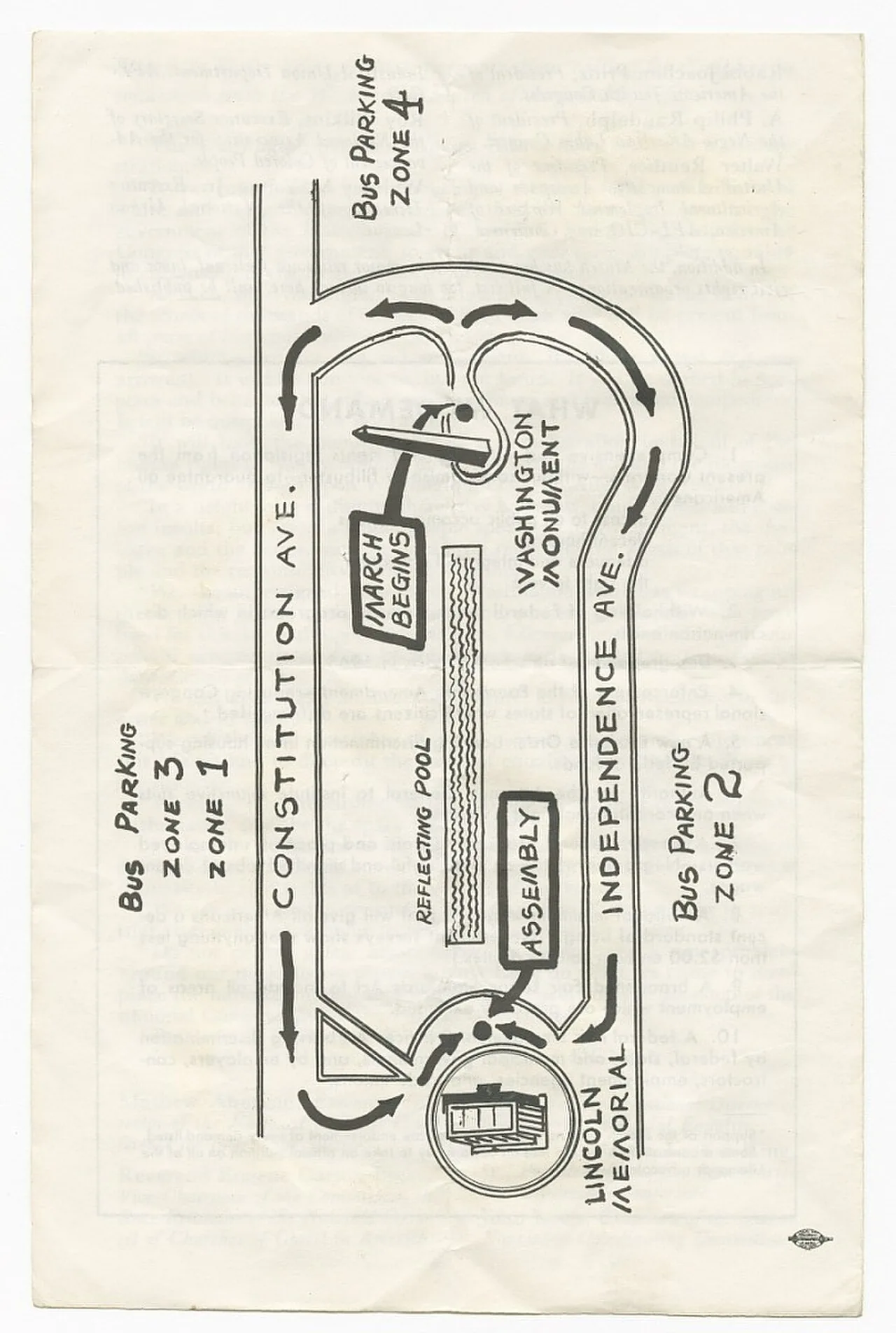
[Hand-drawn map of the march route on the National Mall, printed sideways. Labels as printed:]
WASHINGTON MONUMENT
MARCH BEGINS
REFLECTING POOL
CONSTITUTION AVE.
INDEPENDENCE AVE.
ASSEMBLY
LINCOLN MEMORIAL
BUS PARKING ZONE 1
BUS PARKING ZONE 2
BUS PARKING ZONE 3
BUS PARKING ZONE 4
[Arrows show the marchers going from the Washington Monument along both avenues to the Lincoln Memorial. Zones 3 and 1 share one label north of Constitution Avenue. Union printer's mark in the lower right corner.]