In September 1990, six months after she stood up with her sign at President Bush's AIDS speech (Talk Is Cheap), Urvashi Vaid took a different kind of stand. She went before the Senate Judiciary Committee to argue against the President's nominee to the Supreme Court.
The nominee
In July 1990 Bush nominated David Souter, a federal appeals judge and a former justice of the New Hampshire Supreme Court. Souter had written so little on the big constitutional questions of the day that the press called him a "stealth" nominee. Groups on every side tried to read his record for clues.
The hearing
On September 19, 1990, Vaid testified as executive director of the National Gay and Lesbian Task Force, on a panel that also included Haywood Burns, past president of the National Lawyers Guild, and Paula Ettelbrick, legal director of the Lambda Legal Defense and Education Fund.
When her turn came, Senator Edward Kennedy, chairing the session, stumbled over her name and asked if he had it right. (The Library of Congress says it as ÛR-və-shē VAD.) "Actually, it is Urvashi Vaid," she answered, "but you join an honorable tradition of people who mispronounce the name."
Her case
Vaid built her case against Souter in three parts:
- Adoption. As a New Hampshire justice, Souter had joined an advisory opinion telling the state legislature that a proposed law banning gay and lesbian people from adopting or fostering children would be constitutional. As Vaid described it, the court called the ban a reasonable response to the bill's stated concern of providing "appropriate role models for children." She spent most of her time on this case, and told the senators that Souter had ignored the evidence in its record.
- Privacy. In his hearings Souter had spoken of a fundamental right to privacy for married couples. Vaid called that "narrow statement" a step backward, since the Court had already recognized privacy rights for unmarried people. At the time, Bowers v. Hardwick (1986) still allowed states to make gay sex a crime.
- The military. Challenges to the ban on gay and lesbian service members were working their way through the courts. She called it perhaps the most moving equal-protection question the Court would face in the near future.
The committee approved Souter, and the full Senate confirmed him on October 2, 1990, by a vote of 90 to 9.
The postscript
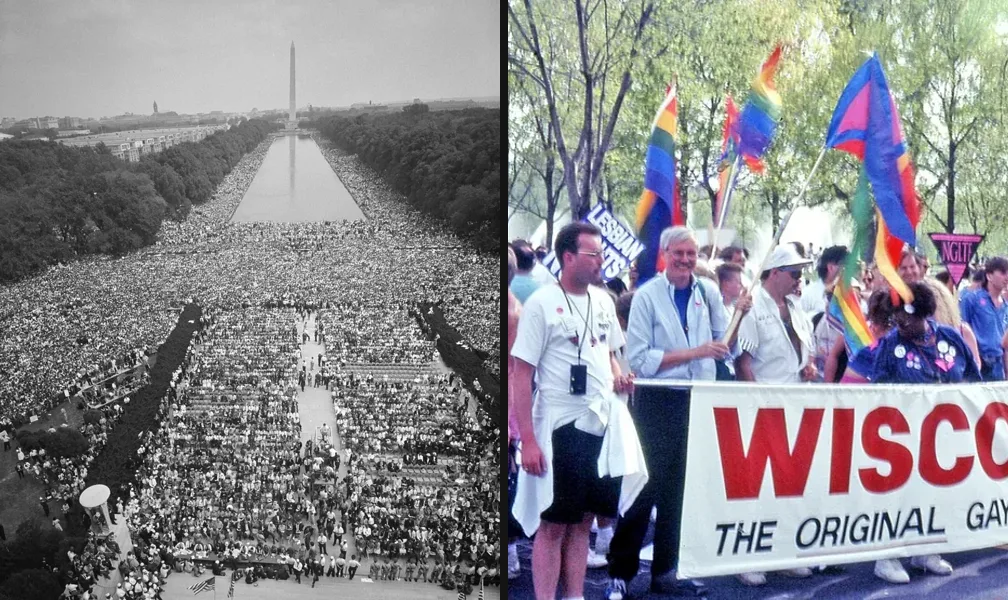
Vaid's fears about Souter did not come true. On the Supreme Court he moved steadily toward its liberal wing. In Romer v. Evans (1996), he joined the six-justice majority that struck down Colorado's Amendment 2, the anti-gay measure whose passage Vaid had mourned at the 1993 March on Washington. In Lawrence v. Texas (2003), he joined the majority that overruled Bowers v. Hardwick and ended the country's sodomy laws.
Her testimony still matters, though not as a prediction. It shows a gay rights leader in 1990 arguing in the most official room in Washington that the Constitution's promises had to include gay people, years before the Court agreed.
Sources
- Nomination of David H. Souter to be Associate Justice of the Supreme Court of the United States: Hearings before the Committee on the Judiciary, United States Senate, S. Hrg. 101-1263 (1990), Vaid's testimony at pp. 811–813 and her prepared statement from p. 814 (govinfo).
- Romer v. Evans, 517 U.S. 620 (1996); Lawrence v. Texas, 539 U.S. 558 (2003).
- Library of Congress, National Library Service, "Say How?" pronunciation guide.